
PART 1
The radiator in my small studio apartment in Center City Philadelphia used to clank all night long, a steady rhythm that reminded me of what it took to build a life from scratch. My CPA certificate hung framed above my desk—a quiet testament to late nights, student loans paid off penny by penny, and independence earned without a single dime of help from my family.
I had spent fifteen years keeping a safe emotional distance from my mother, Eleanor, and my older brother, Julian.
In our family, Julian was the sun around which everything revolved. When he wrecked his first sports car at nineteen, my parents bought him a second one. When his first restaurant venture collapsed, my father quietly paid off the vendors. Julian was charming, persuasive, and utterly incapable of taking responsibility for his choices.
I was the daughter who was expected to be fine. So I was. I moved to the city, passed my board exams, and built a quiet, stable life.
Then, six months ago, my father called me. His voice was thin and raspy, stripped of its usual warmth by the aggressive stage-four cancer that was taking his body.
“Briana,” he had whispered softly into the receiver. “I need you to come home. I can’t do this alone, and your mother… your mother can’t face it.”
I packed two bags, took an extended leave of absence from my accounting firm, and moved into the small guest room of my childhood home in Leesburg.
For six months, I managed his medications, scheduled his hospice care, handled his daily nutrition, and sat beside his bed through the dark, agonizing hours of the night.
Julian came by twice. Both times, he stayed for less than twenty minutes, complained about the traffic, asked our father for “an advance on his inheritance” to handle an urgent investment opportunity, and drove away in his leased European sedan.
My father died on a chilly Tuesday evening in late October, holding my hand while rain tapped against the windowpane.
Three days later, we held the memorial service in the parlor of the family home. Forty neighbors, former colleagues, and old friends filled the room with soft murmurs, offering condolences over plates of cold sandwiches and lukewarm coffee.
I was sitting in the corner, exhausted to my very bones, when Julian tapped a silver spoon against his glass.
The room fell silent. Julian stepped toward the center of the rug, adjusting his tailored suit jacket.
He didn’t speak about our father’s thirty years of service as a public school principal. He didn’t mention my father’s kindness or his devotion to the community.
“Friends,” Julian began, his voice laced with a rehearsed, dramatic somberness. “As you know, my father’s passing leaves us with complex financial transitions. Due to severe, unforeseen business obligations and personal debts amounting to $340,000, I will be placing this house on the market at the end of the week.”
A collective gasp rippled through the room. Neighbors looked at one another in discomfort.
My mother, sitting in a velvet wingback chair under the front window, pulled her lace handkerchief to her nose, nodded serenely, and looked directly across the room at me.
“Your sister can find somewhere else to live,” she said loudly, her voice ringing clearly over the quiet room. “Julian needs his life back.”
I sat frozen, the blood rushing in my ears like a sudden storm.
PART 2
The sheer cruelty of the moment felt like a physical blow. I had spent six months putting my career on hold, bathing my dying father, and managing his medical care while Julian gambled away his life in private clubs.
And now, in front of forty people who had known my father for decades, I was being dismissed like an unwanted tenant.
Before I could pull myself up from the armchair to respond, a voice spoke up from the doorway leading into the hallway.
“Julian,” the voice called out softly, yet with absolute authority. “I suggest you sit down and put your glass down before you say another word.”
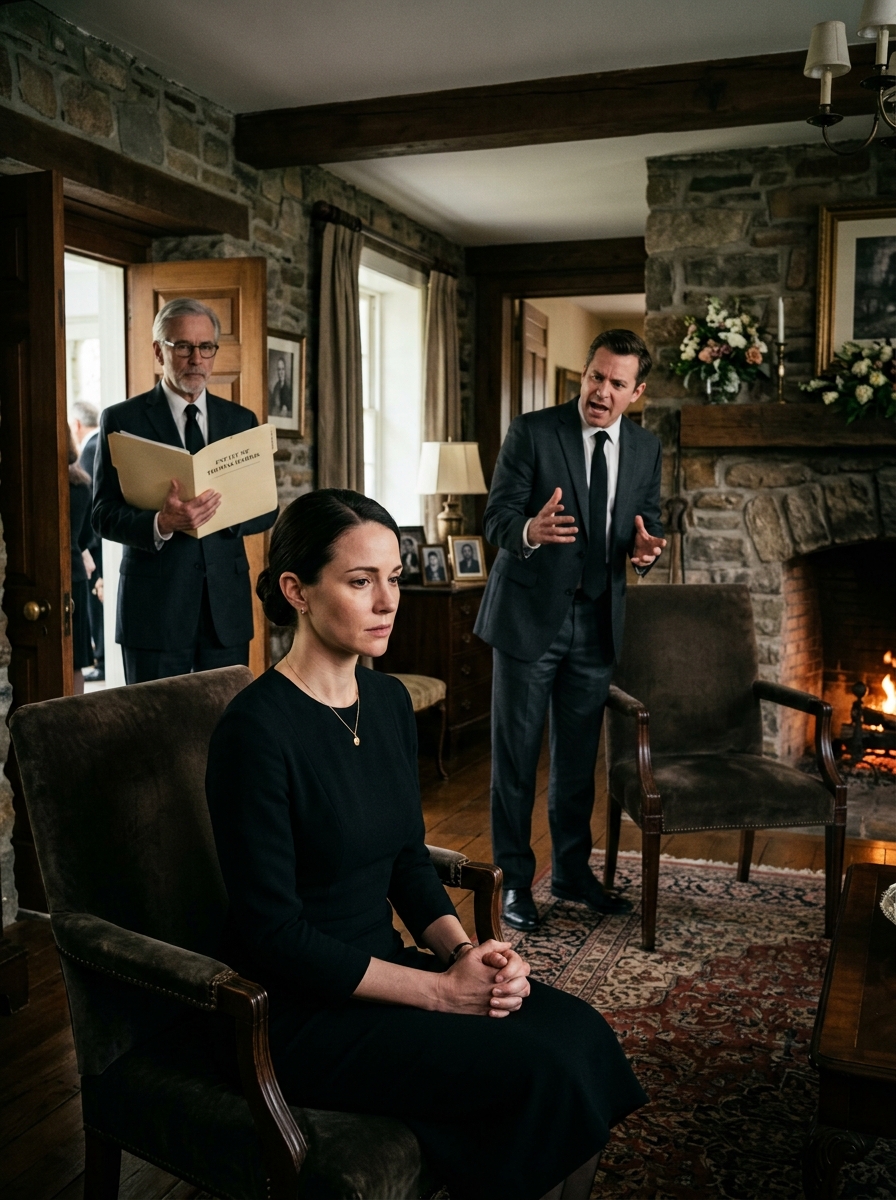
Arthur Vance, my father’s estate attorney and lifelong friend, stepped into the center of the room. He was sixty-eight years old, dressed in a sharp charcoal suit, carrying a worn leather briefcase that had been by his side for thirty years.
Julian frowned, a flash of irritation breaking through his rehearsed composure. “Arthur, with all due respect, this is a family matter. The estate transitions to my mother and me as the primary heirs. We have discussed this.”
“You have discussed it, Julian,” Mr. Vance said, pulling a pair of reading glasses from his breast pocket and slipping them onto his nose. “Your father, however, discussed something entirely different with me three weeks before he passed.”
Mr. Vance opened his briefcase and pulled out a thick Manila folder stamped with a red corporate seal.
“Six months ago,” Mr. Vance continued, addressing the room calmly as if giving a lecture, “when Briana moved back into this house to provide full-time hospice care for Richard, your father asked me to conduct a full forensic audit of his personal accounts.”
My mother sat up straight in her chair, her handkerchief dropping to her lap. “Arthur… what are you talking about? Richard’s accounts were fine.”
“They were fine until two years ago, Eleanor,” Mr. Vance replied, looking at my mother with a quiet, sad pity. “Between March 2024 and September 2025, over $210,000 was systematically withdrawn from Richard’s primary retirement fund through electronic transfers authorized via online banking access.”
Julian’s face flushed a deep, mottled red. “My father gave me permission to manage those funds! It was an investment portfolio—”
“It was high-stakes sports gambling through offshore online portals, Julian,” Mr. Vance interrupted firmly. “And it wasn’t an investment. You used your mother’s access codes to transfer those funds without your father’s knowledge while he was undergoing chemotherapy.”
A sudden, suffocating hush fell over the room. Several neighbors shifted uncomfortably; two of my father’s oldest friends folded their arms, their eyes narrowing as they looked at my brother.
“My father found out in August,” Mr. Vance said, looking down at the papers in his hand. “He didn’t confront you because he was too weak to endure the argument. But he did make a decision.”
PART 3
Mr. Vance pulled a stapled document from the folder, the gold notary seal gleaming under the parlor chandelier.
“On October 2nd,” Mr. Vance read aloud, “Richard executed a formal, legally binding Deed of Trust and Will Codicil. Under Section 4 of the revised estate plan, this property—valued at $780,000—was removed entirely from the general probate estate.”
Julian took a step forward, his fists clenched at his sides. “He can’t do that! My mother is the surviving spouse! She has a statutory right to the marital home!”
“She would,” Mr. Vance agreed, turning a page. “Except for the fact that Eleanor signed a formal secondary spousal waiver three years ago when Richard refinanced the mortgage to pay off your failed restaurant lease in Philadelphia. Under that agreement, Richard held sole, unencumbered title to the real estate.”
Mr. Vance looked up from his glasses and looked directly at me.
“Three weeks ago, Richard transferred full, one-hundred-percent ownership of this home, along with its entire contents and the remaining liquid accounts, into an irrevocable private trust.”
“Whose trust?” my mother choked out, her voice trembling with sudden realization.
“The Briana Henderson Legacy Trust,” Mr. Vance announced clearly, his voice carrying to every corner of the room. “Briana is the sole trustee and sole beneficiary. The property belongs entirely to her, effective the moment of Richard’s death.”
Julian looked as if he had been struck across the face. “This is insane! She bribed him! She manipulated an old, sick man while he was on morphine!”
“I am a Certified Public Accountant, Julian,” I said, finally standing up from my chair, my voice calm, steady, and entirely free of the tremble that had held me for years. “I don’t bribe people. I audit them.”
Mr. Vance nodded approvingly at me before turning back to Julian. “Furthermore, Julian, your father added an explicit debt-offset clause to his final ledger. The $210,000 you misappropriated from his retirement accounts has been formally categorized as an early inheritance distribution. The remaining $130,000 of your debt remains your personal, unbacked liability. The trust will not cover a single penny of it.”
“And what about me?” my mother cried out, standing up from her velvet chair, her hands shaking as she looked at Mr. Vance. “Where am I supposed to live? My own husband left me with nothing?”
Mr. Vance reached into the folder and pulled out one final sheet of paper—a short, handwritten letter in my father’s bold, familiar script.
“Richard left a note for you, Eleanor,” Mr. Vance said softly. “Would you like me to read it, or would you prefer to read it in private?”
“Read it,” my mother whispered, her face pale. “Read it right now.”
ENDING
Mr. Vance cleared his throat and read my father’s final words to his wife:
*”Eleanor,”* the letter began. *”For forty years, I watched you enable Julian’s destructive choices while treating our daughter as if she were a stranger in her own home. When I fell ill, Julian vanished, and you looked away while he emptied my retirement account. It was Briana who held my hand every night. It was Briana who gave up her life to make sure I died with dignity. I am giving her the house because she earned it through love, not entitlement. You will have a life estate in the small cottage in Vermont that my mother left me, funded by my life insurance policy—on the strict condition that Julian’s name is never added to the title. If you give him a single room, the cottage reverts to Briana as well. It is time for you to stop destroying our family to protect a man who will not save himself.”*
The parlor was utterly silent when Mr. Vance finished reading.
My mother dropped back into her chair, covering her face with her hands, weeping quietly—not out of grief for my father, but out of the sudden, devastating realization that her years of enabling Julian had finally reached their absolute end.
Julian didn’t say another word. He looked around the room, realizing that every neighbor, friend, and colleague was looking at him with deep, quiet disgust. He turned on his heel, pushed past the guests, and slammed the front door behind him as he walked out into the rain.
Over the next three months, the reality of my father’s final plan unfolded with quiet precision.
Julian was forced to file for personal bankruptcy to manage his debts. Without my father’s accounts to draw from, he was forced to sell his luxury sedan, give up his downtown apartment, and take a job as an assistant manager at a regional auto supply store.
My mother moved up to the small, cozy cottage in Vermont. She lives there quietly now, supported by the modest monthly stipend my father set up for her through Mr. Vance’s office. She calls me once a week—not to make demands or complain, but simply to ask how my day was, slowly learning how to build a relationship with a daughter she had ignored for thirty years.
As for me, I didn’t sell the stone colonial home.
I moved my accounting practice out of Center City Philadelphia and opened a private firm right here in Leesburg, setting up my main office in my father’s old study.
Every evening, after the last client leaves, I sit by the fireplace in the quiet parlor where my father once read his history books. The house is no longer filled with tension, demands, or hidden secrets. It is filled with warmth, quiet strength, and the deep, enduring peace of knowing that truth, given enough time, always finds its way home.


