
PART 1
The damp, chilly air of early November clung to the windows of City Bus #408 as it screeched to a halt along 4th Street. It was 5:15 AM, an hour when the city belonged entirely to shift workers, hospital staff, janitors, and people too tired to talk.
Clara, a fifty-eight-year-old transit driver who had driven Route 6 for over twenty years, pulled the lever to swing open the pneumatic doors. Standing alone under the buzzing yellow streetlamp was Lily.
Lily was seven years old, wrapped in a faded yellow raincoat, a bright pink backpack slung over her small shoulders. In her right hand, she dragged a battered, black hard-shell violin case that looked hilariously oversized for her tiny frame.
“Morning, sweetheart,” Clara said, her voice a warm anchor in the dreary morning gloom. “Mind the step.”
“Good morning, Ms. Clara,” Lily murmured politely, stepping up onto the rubberized floorboards.
She walked down the aisle to her regular seat in the third row, right behind the long-haul commuters who rode Route 6 every single weekday. Lily rested the heavy violin case between her knees, guarding it with both hands as if it were made of spun glass.
“Still practicing every morning at 5:00 AM?” Clara asked, glancing at the girl through the big curved rearview mirror as she pulled the heavy bus back into traffic.
“Yes, ma’am,” Lily replied shyly, clutching the handle. “Mr. Harrison lets me use the basement storage room at the 8th Street Community Center until six-thirty when the janitor unlocks the main doors.”
A man sitting across the aisle—a middle-aged corporate attorney named Marcus who rode the express line to the financial district every morning—looked up from his glowing tablet.
He had seen the little girl with the big instrument box for weeks, internally assuming her parents were overbearing hyper-achievers forcing a second-grader into intense musical discipline.
“Why practice at five in the morning, kiddo?” Marcus asked, offering a gentle, curious smile. “Couldn’t you play after school at home?”
Lily looked down at her muddy sneakers, her small fingers tightening on the latches of her case. “Our apartment walls are real thin,” she said softly, her voice barely carrying over the hum of the diesel engine. “If I play at home, it wakes up the neighbors. And my mom… she works the overnight cleaning crew at the medical center. She gets home at four in the morning. If I practice at home, she can’t sleep.”
Marcus went quiet, his fingers freezing over his screen. Several other passengers—a surgical nurse in blue scrubs, a weary-eyed line cook, and an older woman carrying a binder of invoices—all turned their heads toward the third row.
Clara looked at the child in the mirror, her heart aching. “You must really love that violin, Lily,” Clara said gently. “You wanna be famous someday? Play in big concert halls?”
Lily shook her head slowly. She swallowed hard, staring straight at the brass latches of her case as a single, silent tear spilled over her lashes.
“No,” Lily whispered softly into the quiet bus. “I just want my mom to stop working two jobs.”
PART 2
A suffocating, absolute silence fell over Bus Route 6.
The background noise of rustling newspapers, tapping phone screens, and low chatter evaporated instantly. For a solid thirty seconds, the only sound in the vehicle was the rhythmic click-clack of the tires over the wet pavement seams and the steady sweep of the windshield wipers.
Marcus sat unmoving in his seat. He thought about his own seven-year-old daughter at home, asleep in a heated bedroom surrounded by expensive toys, complaining whenever she had to do fifteen minutes of piano homework.
Here was a child standing in the dark at five in the morning, carrying twenty pounds of wood and steel across six city blocks, just to protect her exhausted mother’s sleep.
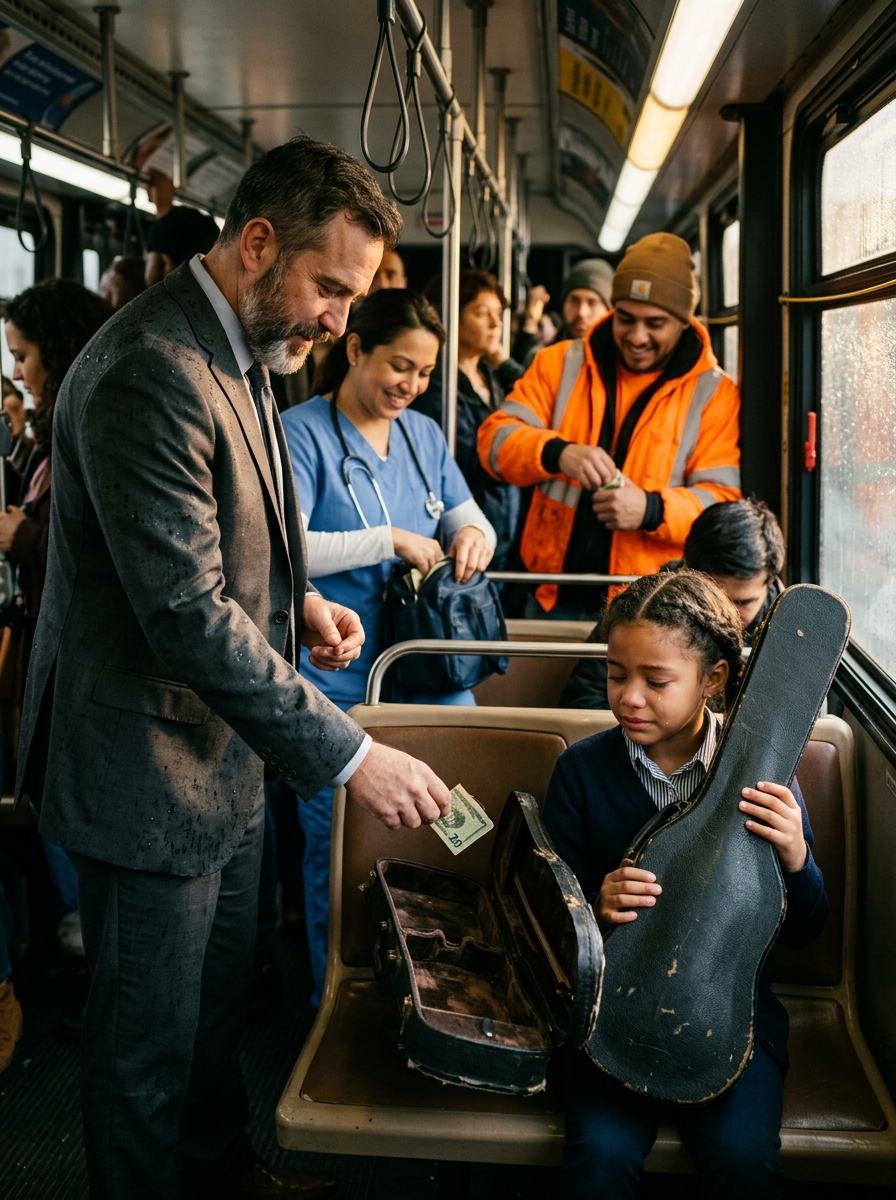
Without saying a word, Marcus unbuttoned his suit jacket, reached into his leather wallet, and pulled out a crisp twenty-dollar bill. He stood up, stepped across the aisle, and gently unlatched the top two buckles of Lily’s violin case, resting the bill neatly inside against the frayed blue velvet.
Lily looked up, her eyes wide with shock. “Oh… sir, no, I can’t—”
“It’s not a donation, Lily,” Marcus said, his voice unusually thick with emotion as he patted her shoulder. “It’s an investment. Keep practicing.”
Before Lily could process what was happening, the surgical nurse stood up from row five. She pulled a folded fifty-dollar bill from her pocket and dropped it into the case. “For resin and new strings, sweet girl,” she whispered, offering a warm, motherly nod.
Then the line cook stepped forward, placing two ten-dollar bills inside. Then a young construction apprentice pulled a handful of crumpled ones and fives from his jacket.
Passenger after passenger walked down the narrow aisle of Bus Route 6. People who normally never looked each other in the eye—corporate executives, retail staff, shift workers living paycheck to paycheck—queued up in silence beside a seven-year-old girl’s seat.
By the time Clara pulled up to the 8th Street Community Center stop at 5:55 AM, the velvet interior of Lily’s violin case was completely overflowing with cash.
Clara set the bus in park, wiped a stray tear from her own eye, and walked back to help Lily carry her case down the stairs. Together, they counted three hundred and ninety-four dollars.
Lily stood on the wet sidewalk, holding her case against her chest, crying quiet, overwhelmed tears as she waved at the bus. Inside, dozens of strangers waved back through the fogged glass as Route 6 pulled away into the rising dawn.
PART 3
Time moves on in a city, but Route 6 never truly forgot that Tuesday morning.
For the next few months, Lily continued to ride the 5:15 AM bus, though things slowly began to change. Her mother, Sarah—a thin, tired woman whose eyes carried the deep circles of relentless double shifts—began riding beside her on morning shifts after her night job at the hospital was scaled back to part-time, funded by a local community arts grant that had unexpectedly appeared in her mailbox.
Eventually, as Lily grew older and moved on to middle school, her schedule shifted, and she stopped taking the early morning Route 6 bus altogether. Passengers moved away, new commuters filled the seats, and the story of the $400 violin case faded into local transit lore—a sweet, fleeting memory shared by Clara and a handful of long-time regulars.
Three years later, on a crisp morning in July 2026, Clara was halfway through her morning shift. She pulled Bus #408 into the gas station terminal for her scheduled fifteen-minute break.
Stepping inside the convenience store to buy a cup of black coffee, Clara picked up a copy of the *City Daily Gazette* lying on the counter.
Halfway down page three, a prominent headline caught her eye:
**LOCAL PRODIGY, 10, EARNS FULL SCHOLARSHIP TO NATIONAL CONSERVATORY OF MUSIC**
Clara stopped breathing.
Directly below the headline was a large, sharp photograph of a ten-year-old girl standing proudly on the stage of a grand auditorium. She was holding a beautiful, high-grade full-sized violin, dressed in a neat black recital dress. Her posture was confident, her smile radiant, and standing right beside her, weeping openly with pride, was her mother, Sarah.
The article detailed how the young girl had auditioned against eight hundred candidates nationwide, securing one of only three fully funded boarding scholarships to the prestigious academy in New York.
Clara’s hand shook as her eyes traced down to the final paragraph of the story, where the reporter had interviewed the young musician about her early beginnings.
The last two lines of the article brought the fifty-eight-year-old bus driver to tears right there in the middle of the gas station aisle.
ENDING
The article concluded with a direct quote from ten-year-old Lily:
*”People think talent comes from expensive tutors or private academies,” Lily told the paper. “But my music started on a city bus at five o’clock in the morning. When my mom couldn’t afford my first real instrument or lessons, thirty strangers on a morning commute paid for my future out of their own pockets. My very first scholarship didn’t come from a university. It came from the passengers on Bus Route 6.”*
Clara folded the newspaper carefully, her chest swells with an overwhelming, profound sense of joy. She paid for the paper, walked back out to her bus, and taped the article directly onto the glass partition right behind her driver’s seat.
As the morning sun finally broke through the clouds, lighting up the streets of the city, Clara swung the bus doors open for the morning rush.
Throughout the day, as tired commuters climbed aboard complaining about the traffic, the heat, or the long workday ahead, Clara would quietly point toward the yellowed newspaper clipping taped beside her head.
“Read that,” Clara would say with a proud, knowing smile as she shifted the bus into drive. “It reminds you that nobody in this town is ever truly riding alone.”