
PART 1
The sound of rain hammering against the windshield usually brought me a quiet sense of comfort, but on that damp Tuesday evening in October, every drop felt like a ticking clock. I pulled my beat-up sedan into the driveway of the two-story split-level home where I had grown up, exhausted from a double shift at the community clinic.
The house was all I had left of my mother, Eleanor. She had spent thirty years cultivating the hydrangeas along the brick walkway, painting the trim, and working overtime as a public school librarian to pay off the mortgage after my father, Richard, walked out on us twelve years ago.
When cancer took her six months past, she left the property solely to me.
I put the car in park, but before my headlights even cut out, my heart slammed against my ribs.
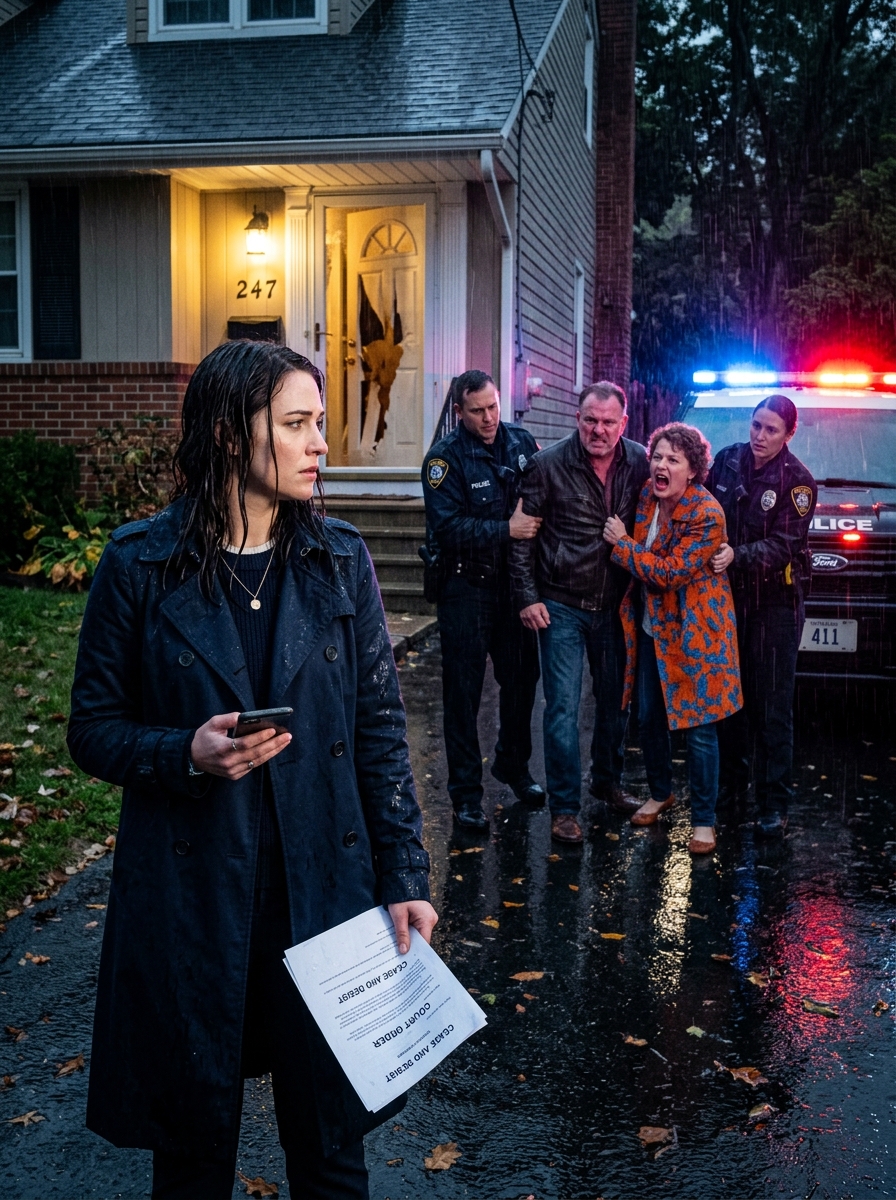
Parked on the street were two massive, unmarked yellow moving vans. The white wooden frame around the front door was shattered, jagged splinters hanging loose against the porch light. A pair of young men in muddy boots were carrying a plush gray sectional sofa directly through the ruined entryway.
Standing in the center of the front lawn under a golf umbrella was Denise—the woman my father had married three years after leaving my mother—shouting orders into her phone while pointing wildly toward the upper floor windows.
I shoved my car door open and stumbled into the rain, my breath catching in my throat. “What are you doing?!” I shouted, my voice cracking over the sound of the downpour. “Stop! What is going on here?!”
Denise turned around, her heavily drawn eyebrows pinching together in mock pity before settling into a cold, triumphant smirk. She turned toward the neighboring houses where two elderly couples had stepped onto their porches to watch.
“WE’RE MOVING IN, CHLOE!” Denise yelled at the top of her lungs, ensuring every neighbor on the block heard every word. “YOUR FATHER HAS A RIGHT TO HIS OWN HOME! GET USED TO IT!”
My father, Richard, stepped out from around the side of the house, wearing a dark rain jacket and holding a crowbar. He offered me a soft, patronizing smile—the exact same smile he used when he told ten-year-old me that he was just “going on a long business trip” a decade ago.
“Chloe, sweetheart, calm down,” Richard said, stepping forward as if to pat my shoulder. I recoiled, backing into the rain. “We tried talking to you like adults.
You’re twenty-eight, drowning in medical bills, and living alone in a four-bedroom house that’s completely too big for you. It’s irrational. Denise’s boys need space, and as Eleanor’s surviving legal spouse from the original loan, I’m consolidating our family assets.”
“You divorced her twelve years ago, Richard!” I screamed, tears scalding my cold cheeks. “She bought out your share! You have no right to be on this property!”
“The court records from the nineties were messy, Chloe,” Richard replied smoothly, nodding toward the movers. “My legal team is looking into the transfer paperwork. In the meantime, we’re occupying the premises. Now go inside, dry off, and we’ll talk about which bedroom you can keep.”
My chest burned. Every impulse inside me wanted to grab his crowbar and scream until my lungs failed. But as I looked at Denise’s sneering face and my father’s calm, calculating posture, my mother’s voice echoed in my head: *Never let a loud person drag you into a shouting match when the truth is on paper.*
I didn’t yell. I pulled out my phone, backed away toward the street, and dialed 911.
PART 2
Ten minutes later, two local police cruisers pulled up to the curb, blue lights reflecting off the wet asphalt.
Denise immediately marched toward the lead officer, her arms flailing dramatically. “Officer! Thank goodness you’re here! This young woman—my stepdaughter—is having a severe mental breakdown and trying to block us from entering our own family home!”
The senior officer, a middle-aged sergeant with graying hair named Officer Vance, looked past Denise toward me. “Ma’am? Are you the homeowner?”
“I am,” I said, stepping forward. My hands were shaking, but my voice remained razor-sharp. “This is my property. My mother passed away six months ago and left the house exclusively to me. These people smashed my front door frame with a crowbar and are trespassing.”
“That’s a lie!” Denise shrieked. “Richard is the original owner! He built this life!”
“Richard signed a quitclaim deed in 2014 following their divorce settlement,” I told Officer Vance, opening my shoulder bag and pulling out a laminated folder I had carried in my trunk since my father first threatened to visit three weeks ago. I handed the officer the certified copy of the county deed, the divorce judgment, and my mother’s probation-stamped will.
Officer Vance reviewed the documents under his flashlight, his expression hardening. He turned to my father. “Sir, do you have any legal documentation granting you right of entry or occupancy today?”
Richard shifted his feet, his calm exterior beginning to crack. “Officer, my lawyer is preparing a petition to dispute the 2014 deed transfer—”
“A petition is not an order of possession, sir,” Vance interrupted firmly. “You do not have a court order, and you do not have permission from the deed holder.”
I reached into my pocket and unlocked my phone. “I also have the live feed from my ring camera installed under the porch light. It captured Mr. Vance breaking the door frame with that crowbar fifteen minutes ago.”
Officer Vance looked at my father, then at the two movers standing awkwardly on the porch holding a coffee table.
“Moving crew, put the furniture back in the truck and step off the property,” Vance commanded sternly. He then turned directly to Richard and Denise. “Sir, ma’am, if you do not vacate this property in three minutes, I will arrest you both for felony breaking and entering and criminal trespass.”
Denise’s face went completely purple with rage. “You can’t do this! This is a family matter!”
“It’s a criminal matter the second a crowbar hits a door frame, ma’am,” the officer replied, taking his handcuffs off his belt. “Move. Now.”
Watching Denise sputter in absolute humiliation as she was escorted back to her SUV under the watchful eyes of my entire neighborhood was the most satisfying sight of my adult life. Richard tried to catch my eye as he walked past, but I looked straight through him.
By 8:00 PM, the moving trucks had rumbled away, the police had taken my statement, and silence settled over the rain-soaked lawn. I stood on the porch, exhausted but victorious.
Then I noticed the side gate to the backyard was swinging open in the wind.
PART 3
I walked slowly down the muddy side path toward the backyard, carrying a heavy flashlight.
The door to my mother’s small wooden garden shed was standing wide open. Inside, bags of potting soil had been sliced open, and my mother’s antique gardening tools were scattered across the floorboards.
In the back corner of the shed, a heavy stone paver had been pried up, exposing a shallow concrete pit. Inside the pit lay an rusted steel firebox—its heavy brass padlock cut cleanly in two by a pair of bolt cutters lying nearby in the dirt.
My father hadn’t broken into my house because he wanted a place for Denise’s sons to live. He had staged an entire home invasion as a distraction to search the backyard.
My heart pounding, I knelt in the damp sawdust and lifted the heavy iron lid of the firebox.
Inside were three thick, leather-bound accounting ledgers, a stack of original corporate share certificates from 1998, and a sealed manila envelope addressed to me in my mother’s neat, looping handwriting.
I carried the box inside the house, locked the temporary deadbolt the police locksmith had installed on my front door, and sat down at the kitchen table.
I tore open the manila envelope. Inside was a letter dated two weeks before my mother died, alongside a set of notarized financial audits.
*My dearest Chloe,* the letter read.
*If you are reading this, it means Richard has finally tried to claim what he thinks he was owed. For twelve years, your father told the world that he left our family with nothing because his commercial construction firm went bankrupt. That was his greatest lie.*
*In 1998, before he abandoned us, Richard secretly transferred thirty percent of his firm’s commercial equity into an offshore holding company to hide it from our divorce proceedings. But he made one critical mistake: he used our home’s original property deed as the collateral anchor for the holding firm’s registration.*
*I discovered the paper trail four years ago with the help of a private auditor. I didn’t enforce the claim then because I wanted to protect your peace while I was sick. But the law is clear: because he used our joint property collateral without my consent, thirty percent of his current multimillion-dollar construction firm actually belongs to the owner of this house.*
*I left the house to you, Chloe. Which means you don’t just own this roof over your head. You own his entire life.*
ENDING
The next morning, I didn’t waste time with angry phone calls or dramatic confrontations. I walked directly into the offices of a high-profile corporate litigation attorney downtown, handing him the ledgers, the share certificates, and the forensic audit my mother had meticulously assembled.
When my father received the legal notice four days later, he thought it was a trespass warning. Instead, it was an emergency petition for asset freeze and corporate receivership filed in county chancery court.
The fallout was swift and absolute.
Forensic accountants confirmed that Richard’s entire commercial enterprise had been built on the fraudulent collateral scheme he executed during his marriage to my mother. Facing catastrophic federal tax fraud charges and total corporate liquidation, Richard was forced into an immediate settlement.
Under the terms of the court-approved agreement, I received a lump-sum payout of $1.4 million representing my mother’s rightful back-equity, along with full, unencumbered ownership of our home.
Denise left my father less than three months later, taking her sons and returning to Sacramento the moment his credit lines were frozen and his luxury vehicle was repossessed.
Today, at twenty-eight, I have fully restored my mother’s home. The shattered front door was replaced with custom solid oak, the mortgage is paid in full, and my mother’s garden flowers bloom brilliantly along the front walk every spring.
My father tried to call me once from a small rented apartment across town, his voice small and defeated, asking if we could “talk about family.” I didn’t shout, and I didn’t insult him. I simply reminded him of the lesson my mother taught me: that some debts don’t expire just because you choose to ignore them—and then I hung up the phone.