
PART 1
The morning sun hit the tall arched windows of Oakridge National Bank, casting long, geometric shadows across the polished terrazzo floors. To the casual observer, it was just another Friday morning, but to me, stepping into that lobby always felt like stepping into my own history.
I walked toward the desk of a loan officer named Ryan. He was young—twenty-five at most—with a sharply pressed suit, a gelled haircut, and an aura of supreme efficiency that usually comes before a person has lived enough life to taste real humble pie.
“Mrs. Gable,” Ryan said, offering a practiced, hollow smile as I sat down across from him. “I reviewed your application for the fourteen-thousand-dollar auto loan on the pre-owned sedan.”
“Wonderful,” I said smoothly, resting my hands on my handbag. “I’m buying it from my neighbor, Arthur. My old station wagon finally gave up the ghost last Tuesday.”
Ryan adjusted his tie, leaning back in his leather chair and steepling his fingers. “Well, here’s the issue. Our automated underwriting system flagged your application for insufficient individual credit history. Beyond a single department store card and a joint mortgage that was paid off fifteen years ago under your late husband’s name, you simply don’t have an active credit footprint in our modern reporting system.”
I stared at him, letting the silence stretch between us. “Ryan, I have maintained four active certificates of deposit in this exact institution for thirty years. My checking account receives a pension deposit on the first of every month.”
“Deposits are assets, Mrs. Gable, not revolving credit lines,” he said, using that slow, deliberate cadence people use when they assume the person across from them is confused by basic technology. “If your husband were still alive, or if you had an adult son who could step in as a primary guarantor or co-signer…”
He let the sentence hang in the air, offering a patronizing little nod of sympathy.
Fifty years ago, that exact sentence would have brought tears of helplessness to my eyes. Fifty years ago, a woman couldn’t open a line of credit, buy a home, or finance a tractor without a husband, father, or brother signing off on her competence.
“I see,” I said softly, standing up from the leather chair and smoothing down the front of my navy coat.
“I’m happy to print out the co-signer paperwork if you’d like to take it home to a male relative,” Ryan added, reaching for a stack of forms on his desk.
“No need, Ryan,” I replied, my voice steady and entirely calm. “Do me a favor. Stand up and walk me out to the main lobby.”
Ryan blinked, momentarily thrown off by my tone. “Excuse me? Mrs. Gable, if you’re upset about the policy—”
“I’m not upset,” I said, offering him a pleasant smile. “I just want to show you something near the entrance.”
Reluctantly, Ryan pushed his chair back and followed me across the polished floor.
PART 2
We walked past the teller line, where several long-time town residents nodded to me in greeting, toward the heavy glass doors that led out to Main Street.
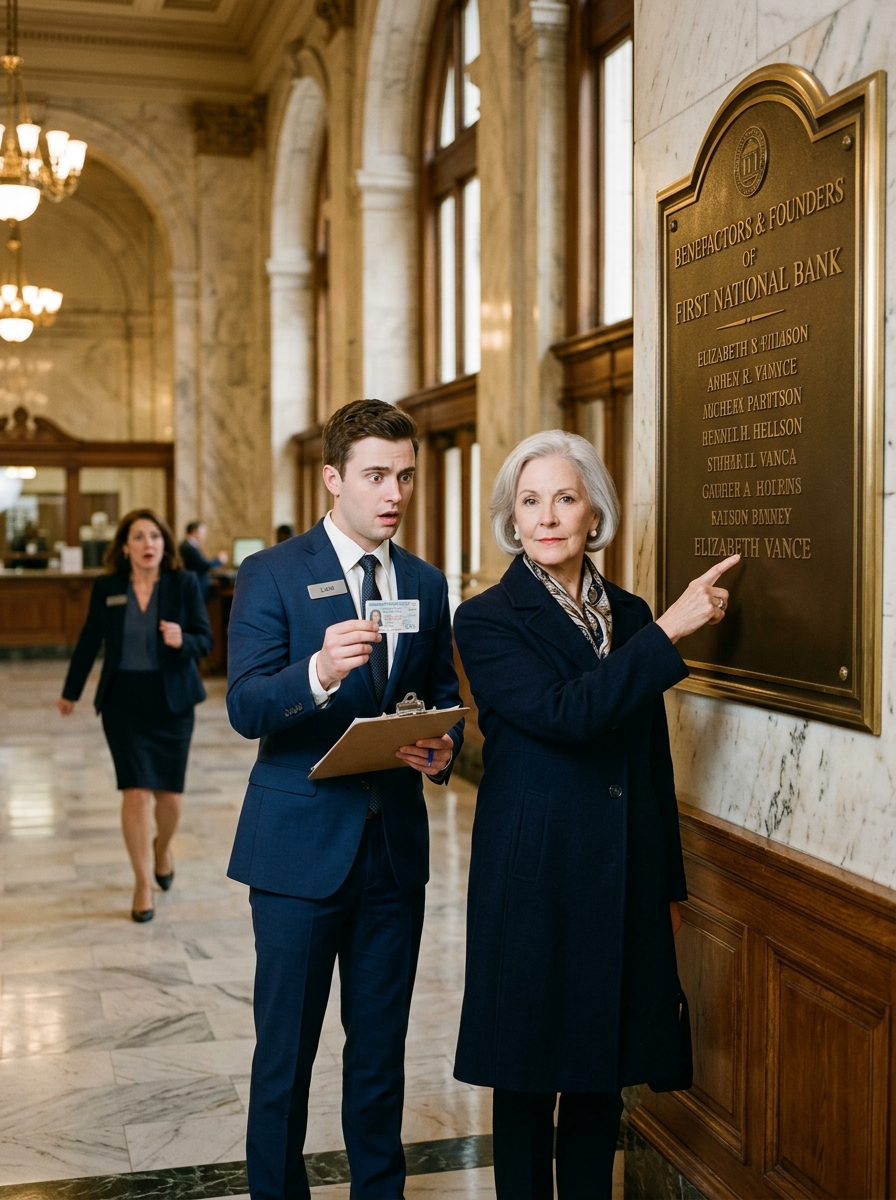
Just to the right of the entrance, mounted flush against the dark oak paneling, was a heavy brass plaque. It had been cleaned and polished so many times over the decades that the sharp edges of the engraved letters had become soft and rounded, but the inscription remained crystal clear:
*DEDICATED OCTOBER 14, 1974*
*TO THE FOUNDING DIRECTORS OF THE OAKRIDGE WOMEN’S CREDIT UNION*
*BUILT ON THE BELIEF THAT FINANCIAL INDEPENDENCE IS A FUNDAMENTAL RIGHT.*
Below the inscription were eleven names listed in alphabetical order.
I stopped in front of the plaque, folded my arms, and tapped my finger directly onto the fourth line down: *Martha E. Vance*.
Ryan stood beside me, shifting his weight awkwardly from foot to foot. “Mrs. Gable, I’m not sure what a historic plaque has to do with your loan application’s credit-scoring algorithm—”
“Read the fourth name, Ryan,” I said gently.
He squinted at the bronze lettering. “*Martha E. Vance*,” he read aloud.
I reached into my handbag, pulled out my leather wallet, and extracted my Oregon driver’s license.
I held it directly beneath the fourth name on the brass plate.
The license read: *Martha Vance Gable*.
Ryan looked at the license. Then he looked at the brass plaque. Then he looked back at my license, his eyes widening in sudden, horrified comprehension.
“In 1974,” I said, my voice quiet but echoing clearly in the quiet lobby, “eleven of us gathered in the basement of Grace Lutheran Church with four thousand dollars of our own saved cash. The big banks in the city refused to give local farm wives or widowed women loans for washing machines, cars, or small business inventory without their husbands’ written consent. So we built our own credit union from scratch.”
Ryan swallowed hard, his throat moving visibly.
“By 1992,” I continued, “our credit union had eleven million dollars in assets. This bank—Oakridge National—was struggling, so they approached us to merge. We agreed, on three conditions: that our members’ rates were protected, that this building retained local staff, and that this plaque stayed beside the front door to remind every young banker who walks through those doors whose shoulders they are standing on.”
The color had completely drained from Ryan’s face. He held his clipboard against his chest like a shield. “Mrs. Gable… I… I didn’t realize…”
“Please wait right here, Mrs. Gable,” he said, his voice trembling slightly. “Please. Don’t move.”
PART 3
Ryan practically sprinted down the hall toward the glass-walled corner executive office. Through the glass, I watched him knock frantically, enter without waiting for a response, and start speaking to the branch manager while pointing frantically back toward the entrance lobby.
A moment later, the door swung wide open.
Out stepped Brenda Miller, the branch manager. Brenda was fifty-two, sharp, impeccably professional, and had worked her way up through the teller ranks twenty years ago. The moment her eyes locked onto me standing beside that brass plaque, her posture shifted from corporate sternness to absolute panic.
“Martha!” Brenda exclaimed, hurrying across the marble floor so fast her heels clicked like rapid gunfire against the stone.
“Hello, Brenda,” I said pleasantly.
“What on earth is going on?” Brenda asked, shooting a deadly look toward Ryan, who was hovering two steps behind her looking like he wished the marble floor would open up and swallow him whole. “Ryan came running into my office claiming there was a major misunderstanding regarding your account auto-approval.”
“Oh, it was no misunderstanding, Brenda,” I said smoothly. “Ryan was simply following your automated underwriting rules. He explained to me that because my late husband, Thomas, passed away seven years ago, my personal credit history is ‘insufficient.’ He very thoughtfully suggested I go home and find an adult male relative to co-sign a fourteen-thousand-dollar car loan.”
Brenda closed her eyes for two agonizing seconds. When she opened them, her gaze cut toward Ryan with enough frost to freeze a lake in July.
“You told the woman who literally co-founded the capital base of this branch that she needed a male co-signer?” Brenda whispered, her tone dangerously quiet.
“I… I just checked the software score, Ms. Miller,” Ryan stammered, his face turning a deep, blotchy crimson. “The system flagged the credit report…”
“The system,” Brenda interrupted sharply, “is an administrative tool. A brain and a knowledge of this institution’s history are required to be a loan officer in this town.”
Brenda turned back to me, taking both of my hands in hers. “Martha, I am deeply, profoundly sorry. Your standing with this bank is unconditional. You hold over four hundred thousand dollars in unencumbered CDs in our vault, and your founding trust charter explicitly grants you top-tier institutional credit standing for life.”
“I know, Brenda,” I smiled gently. “I just wanted to make sure young Ryan here learned that lesson before he turned away the next woman who walked through those doors asking for her own independence.”
ENDING
Ten minutes later, I was sitting in Brenda’s private office while she personally override-processed the paperwork. My $14,000 loan was approved at a zero-point-five percent promotional interest rate—the original founder’s rate established in the 1992 merger agreement—and the bank issued a cashier’s check directly to my neighbor Arthur before noon.
Before I left the building, Brenda insisted that Ryan sit down with both of us in the conference room.
He didn’t look cocky anymore. He looked humble, thoroughly chastened, and genuinely repentant.
“Mrs. Gable,” Ryan said, looking me squarely in the eye without a trace of his earlier condescension, “I want to apologize. I relied entirely on a computer algorithm and my own arrogance, and I completely disrespected your history and what you built for this community. It won’t ever happen again.”
I looked at the young man, seeing the genuine remorse in his face, and felt my sharp edge soften. “Ryan,” I said kindly, “fifty years ago, women fought very hard so that we wouldn’t have to ask permission to live our own financial lives. Don’t ever look at an older woman sitting across your desk and assume she doesn’t know how the world works. Half the time, we’re the ones who laid the brick you’re sitting on.”
He nodded earnestly, offering me a respectful, genuine handshake.
That afternoon, I drove Arthur’s clean, reliable silver sedan home, pulling it into my driveway with a quiet sense of triumph. I didn’t need a husband, a son, or a male co-signer to secure my ride. All I needed was the reminder that dignity isn’t something given to you by a bank officer—it’s something you build, carve in brass, and stand on when the rest of the world forgets.