
PART 1
Grief has a quiet, stubborn geometry to it. For three years, my Sundays at Greenwood Cemetery in Montgomery had followed an unvarying architectural design: church at nine, a quiet lunch with leftover chicken salad, and then the short drive up the hill to Roy’s stone. I brought my own metal clippers for the tough Bermuda grass that crept over the chiseled letters of his name, and fresh flowers cut straight from my own backyard. Store-bought arrangements wrapped in green cellophane were never Roy’s style, and they certainly weren’t mine.
He was a simple, practical carpenter who built cabinets that outlasted mortgages and loved things that grew honestly out of the earth.
Last Sunday, the morning air was thick with the heavy humidity of late summer, and the old groundskeeper, Mr. Otis, was working the section directly adjacent to Roy’s plot. I had waved at Mr. Otis for three years—a familiar fixture of the grounds with his faded straw hat, moving slow and steady as the changing seasons. But this time, instead of nodding and tapping the brim of his hat, he shut off his mower, cut the engine, and walked slowly over across the neatly clipped turf. He wiped his weathered forehead with a handkerchief, looked down at the stone, and then looked at me with an expression of heavy hesitation. “Ma’am,” he said, his voice raspy from decades of dust and sun. “I’ve gone back and forth on whether it’s my place.
But you seem like a lady who’d rather know the truth than walk around in the dark.” He nodded toward the crystal vase sitting on Roy’s headstone, filled with fresh tiger lilies. “You come Sundays. But somebody else comes Tuesdays. Every Tuesday, three years, same as clockwork right about seven in the morning, before most folks are up. Leaves flowers, stands a while, talks some. I figured it was family till last Tuesday, when she saw me looking and asked me real quiet—asked me not to mention her to the Sunday lady.”
PART 2
The Sunday lady. Me. The words hung in the humid air between us like a physical weight. For three years, I had been finding the glass vase fuller than I left it on Sundays, sometimes noticing stems cut shorter or water topped off, and I had foolishly told myself that the groundskeepers just topped it up out of general kindness.
Three years of Tuesdays, seven in the morning, two days behind my Sundays—close enough to share a grave, but careful enough to never share an hour. My heart gave a heavy, nervous thud against my ribs as I looked from Mr. Otis’s troubled face back to the polished granite marker bearing my husband’s name.
I asked what she looked like, my voice barely louder than the hum of a distant highway. Mr. Otis turned his straw hat over and over in his calloused hands, staring down at the grass. “About your age, ma’am,” he said softly. “And she cries the whole time. Every Tuesday. Three years. Ain’t nobody cries like that over a man they didn’t know.” Mr. Otis tipped his hat, said it wasn’t his business to say more, and walked back to his mower because the grass wouldn’t wait for old ghosts. But as he walked away, he stopped, looked back over his shoulder, and added four words that completely dismantled my peace of mind: “Tomorrow’s Tuesday, ma’am.” Monday night crawled past in a haze of broken sleep and racing thoughts.
At six in the morning, long before the sun had fully burned the morning mist off the headstones, I made a pot of coffee I didn’t drink, put on my Sunday church clothes on a Tuesday, and drove the quiet miles back to Greenwood.
PART 3
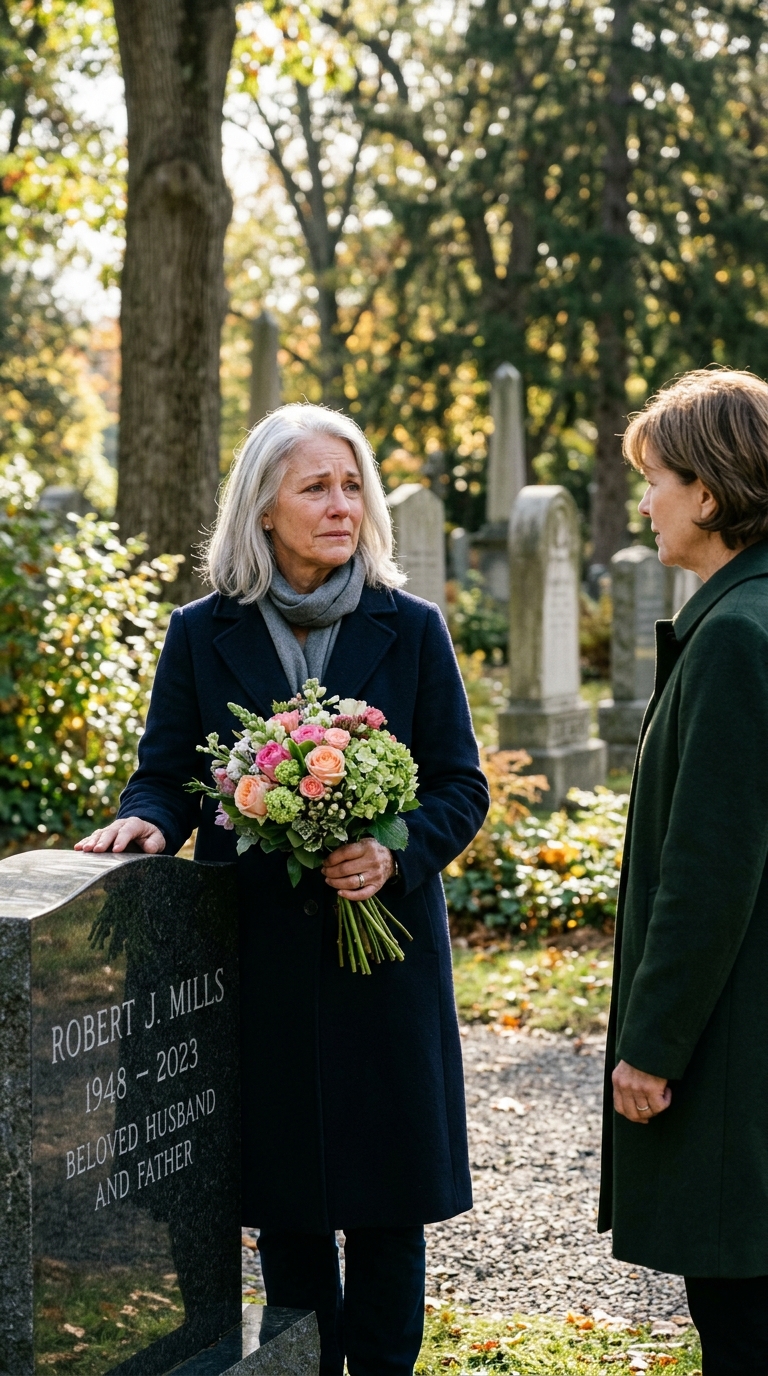
The cemetery was dead silent when I pulled my sedan off the asphalt and parked near the old oak tree. I walked slowly up the slope, keeping my footsteps light against the damp grass, staying hidden behind a cluster of tall marble monuments a few rows away from Roy’s plot. At precisely seven o’clock, a small silver sedan I had never seen before turned down the maintenance lane and parked fifty yards away. A woman stepped out. She was wearing a simple navy cardigan and sensible walking shoes, carrying a modest bunch of yellow chrysanthemums wrapped in brown paper. She walked with a familiar, weary slouch, her head bowed against the morning chill. When she reached Roy’s grave, she knelt down right on the grass without spreading a cloth, laid the flowers in the empty vase, and buried her face in her hands.
The sound of her crying carried across the quiet lawn—not an angry wail, but the deep, shuddering grief of someone whose entire world had cracked open long ago and never quite healed. I watched her trace the letters of Roy’s name with her fingertips, whispering things I couldn’t quite catch over the wind. My hands shook as I gripped the strap of my handbag, a mixture of fear and fierce protectiveness tightening in my chest. Who was she? Why Roy? After standing silently behind the marble monument for nearly twenty minutes, watching her wipe her eyes and prepare to leave, I stepped out from the shadows and called out her name without even knowing it: “You can turn around. I’m the Sunday lady.” The woman froze instantly, her shoulders stiffening as she slowly stood up and turned to face me across my husband’s grave.
ENDING
The woman who stood before me was named Clara, and when she looked into my eyes, the defensive terror on her face melted into a profound, heartbreaking relief. She didn’t run. Instead, she reached into her coat pocket and pulled out a worn, leather-bound journal that belonged to Roy—a private ledger from his construction days that he had kept locked in his truck console, containing a life I had never known existed. Over coffee in a quiet diner down the road, Clara explained that she had been Roy’s business partner and quiet companion during his out-of-state bridge contracts in the final five years before his retirement, sharing a domestic life he never had the courage to dissolve at home. We sat together across the formica table for two hours, two women bound by the same flawed, complicated man, trading stories and tears until the coffee grew cold. When we finally parted ways in the parking lot, we didn’t exchange phone numbers, but as I drove home under the wide afternoon sky, I realized my Sundays at Greenwood would never be lonely again—because grief, as it turns out, is big enough to share with the person who loved him when you weren’t there.


