
PART 1
Time has a quiet way of turning sharp grief into a dull ache, but some absences never truly soften. For our graduating class of 1972, the ghost in the room had always been Danny Brooks. Danny wasn’t the kind of boy who collected class superlatives or letter jackets; he was simply the one who could make Mr. Henderson, our perpetually severe principal, burst out laughing during detention with a dry remark whispered behind a history text. We were young, hopeful, and entirely blind to the larger world when the draft lottery and the escalating war in Southeast Asia tore through our futures.
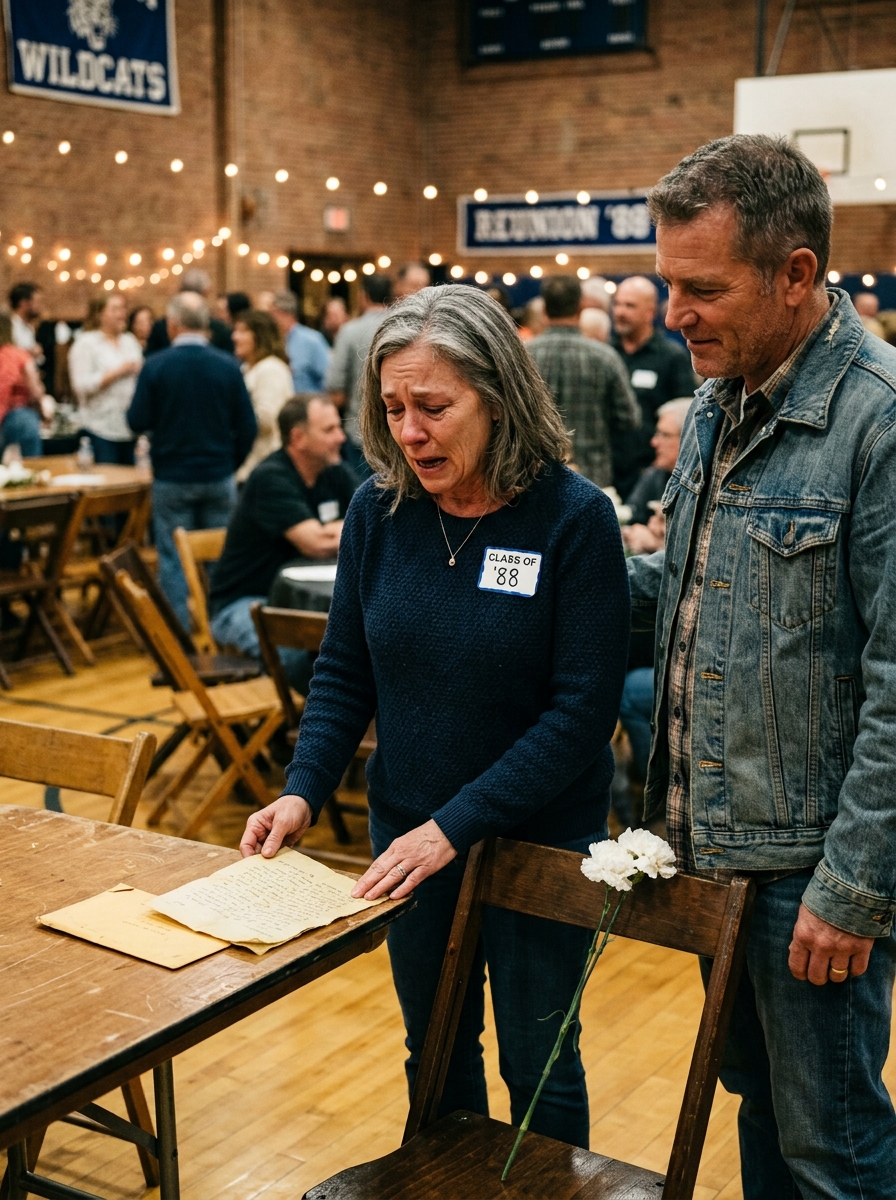
Danny shipped out that August after graduation, volunteering because his family needed the service bonus, and came home the following spring in a heavy wooden box we weren’t legally allowed to open. Fifty years have passed since we walked across that stage, and every single reunion since 1982 has followed the same solemn tradition: the committee sets an empty metal chair draped with a white carnation at the end of the banquet table, a silent placeholder for a boy who never got to grow old.
The annual gatherings always take place in our old high school gymnasium, which still smells faintly of industrial floor wax, faded wood varnish, and cheap fruit punch. We are senior citizens now with silver hair, bifocals, and a shrinking roster of living classmates. This year, I was stationed near the entrance table behind a stack of laminated name tags and a bowl of mints, greeting the slow trickle of aging alumni as they shuffled into the gym.
The air was filled with the familiar, comforting hum of old friends catching up on grandchildren and joint replacements when the room suddenly went very quiet behind me. The laughter tapered off, and a heavy, confused hush rippled across the crowded tables. I turned around, expecting a late arrival or perhaps a catering mishap, and froze. A man none of us recognized—somewhere in his late fifties, dressed in a plain denim jacket with weathered hands and a quiet, deliberate dignity—had walked past the registration table and taken a seat in Danny’s chair. He hadn’t asked permission; he had simply removed his hat, placed it on the floor, and sat down in the empty metal chair as if he belonged there by right of blood.
PART 2
A murmur of disapproval broke out near the refreshment table. Kathleen, our class treasurer and the self-appointed guardian of all reunion protocol, marched across the gym floor wearing her fiercest committee face, her heels clicking sharply against the polished hardwood.
She reached the table, cleared her throat with frosty authority, and began to say that the seat was reserved for a fallen classmate, but the man didn’t flinch. Instead, he stood up slowly, towering over Kathleen with an unhurried grace that stopped her words mid-sentence. Without a trace of defiance or embarrassment, he reached inside his jacket pocket, pulled out something flat, stiff, and yellowed with age, and laid it gently on the white tablecloth next to the carnation.
“I didn’t come to steal a chair,” the man said, his voice carrying a gravelly, Midwestern cadence that cut through the cavernous gym. “I came because my mother told me that if I ever made it to this town, I had to find the girl Danny called home.” The entire gymnasium was dead silent now; you could hear the distant hum of the aging ceiling fans overhead. I stepped out from behind the registration table, my legs feeling suddenly heavy as I walked toward the front of the room.
As I drew closer, I looked down at the flat object resting beside the white carnation. It was an old, dog-eared photograph tucked inside a clear plastic sleeve, alongside a heavily creased letter written on tissue-thin military stationery. Even before I picked it up, the familiar sloping handwriting hit me like a physical blow, pulling me back across half a century to the autumn porch where Danny and I used to sit before the world changed forever.
PART 3
I picked up the weathered letter with trembling fingers, slipping the single sheet of paper out of its envelope. It was dated March 14, 1973—just two weeks before Danny was killed in a mortar attack near the DMZ. The words, scrawled in his rushed, familiar hand, were addressed to me, but the final paragraph carried a message I had never received. *“If I don’t make it back, Sarah,”* he had written, *“there’s something you should know about the family farm up near Oakhaven. I signed over the deed before I left so my sister wouldn’t lose it, but there’s a boy in Saigon who carries my name and deserves to know where he came from.”* I looked up from the paper, my eyes locking onto the stranger standing quietly by the empty chair. The resemblance was undeniable—the deep-set brown eyes, the square jaw, and that same slight crooked smile that had once charmed the principal in detention.
The man introduced himself as Daniel Brooks Jr., born to a young Vietnamese woman who had kept his father’s letters in a tin box for decades until she passed away last year. He explained how he had spent his life piecing together the fragments of an American soldier he had only known through faded photographs and wartime folklore, finally tracking his father’s hometown roots to our high school reunion directory. The hostile murmur in the gymnasium dissolved instantly, replaced by a collective, heavy breath of understanding as Kathleen stepped forward, her stern committee face melting into tears, and quietly pulled an extra chair up to the table. We spent the next three hours not mourning a ghost from fifty years ago, but welcoming his living legacy into the fold, passing around plates of dry chicken and listening to a son talk about a father he never got to hug.
ENDING
That evening ended a half-century of incomplete history for our graduating class. When the gymnasium lights were finally turned off and the folding chairs were stacked against the wall, Daniel walked me out to my car under the cool autumn stars. We stayed in touch in the months that followed, helping him connect with distant relatives and officially establishing a permanent scholarship in Danny’s name at the local community college. The empty chair at our reunion table didn’t disappear the following year, but its meaning changed forever; it was no longer just a monument to a loss, but a bridge to a family restored. Sitting on my front porch with my morning coffee today, looking out at the old maples that line our street, I know that time doesn’t truly erase the past—it simply waits for the right moment to bring our missing pieces home.