
PART 1
Time has a curious way of folding decades into neat, quiet corners of memory until a single ordinary sound or a familiar scent pulls them wide open again. For me, that memory always traces back to the stifling heat of July 1979. The Hollis family lived directly across our gravel lane, their modest farmhouse framed by tall maples that dropped leaves long before autumn truly arrived. That summer, the house across the lane fell into a heavy, suffocating silence when the Hollis girl lost her mother to a sudden illness that swept through the county too fast for anyone to properly comprehend.
She was twelve years old then—a quiet, watchful girl with scraped knees, oversized cotton dresses, and a solemnness in her eyes that no child should ever have to wear. Her daddy, a kind but utterly bewildered man who had spent his entire life behind the wheel of a timber truck, simply did not know what to do with a grieving preteen. He tried his best, burning breakfast toast and packing lunches of saltine crackers and warm ginger ale, but the grief hung over their porch like a persistent summer fog.
One humid Tuesday morning, I watched him drive away in his dented blue pickup, leaving the front screen door rattling in the morning breeze while little Clara sat alone on the top step, staring blankly at the dust settling around her sneakers. I didn’t wait to see if she would come over; I wiped my hands on my flour-dusted apron, walked across the gravel lane, and invited her onto my screened-in porch with a pitcher of iced lemonade and a basket of fresh linen rags.
Because her daddy had no earthly idea how to keep a house running or how to soothe a hurting child, I simply put her to work in my kitchen. All through that long, sun-drenched August, we canned. We stood side by side at the porcelain sink from dawn until the cicadas started their evening hum, washing bushel after bushel of late-summer tomatoes, snapping green beans until our fingers stained purple, and peeling ripe yellow peaches that bruised at the slightest touch. She had small, remarkably quick hands that never seemed to tire, and whenever the heavy, suffocating weight of her loss became too much to bear, she would lean her head against the side of the wooden counter and cry in quiet, shuddering gasps. I never scolded her or told her to stiffen her upper lip; I just handed her a clean tea towel, pulled her small frame into my side, and let her cry until the tears ran dry, then handed her another jar to pack.
PART 2
That autumn brought the inevitable rustle of dry cornstalks and the distant rumble of school buses restarting their morning routes. Just as the first frost touched the pumpkin patches, Mr. Hollis packed their remaining belongings into the back of a rented trailer and moved the family up to Ohio, where an uncle had offered him steady work at a lumber mill. Clara and I stood by the mailbox on a chilly October morning, sharing a quick, tight hug before she climbed into the passenger seat of the truck, clutching a small brown-paper parcel of my leftover cinnamon sugar shortbread. She promised she would write, but in the frantic rush of farm life and the quiet rhythms of aging, the address slipped away, and I never received a single card or letter in the mail. I did not need one to remember her, though; every time I opened the pantry door and saw the neat rows of Mason jars catching the afternoon light, I thought of those small, quick hands and the way she had learned to test the jar seals with a sharp tap of her fingernail.
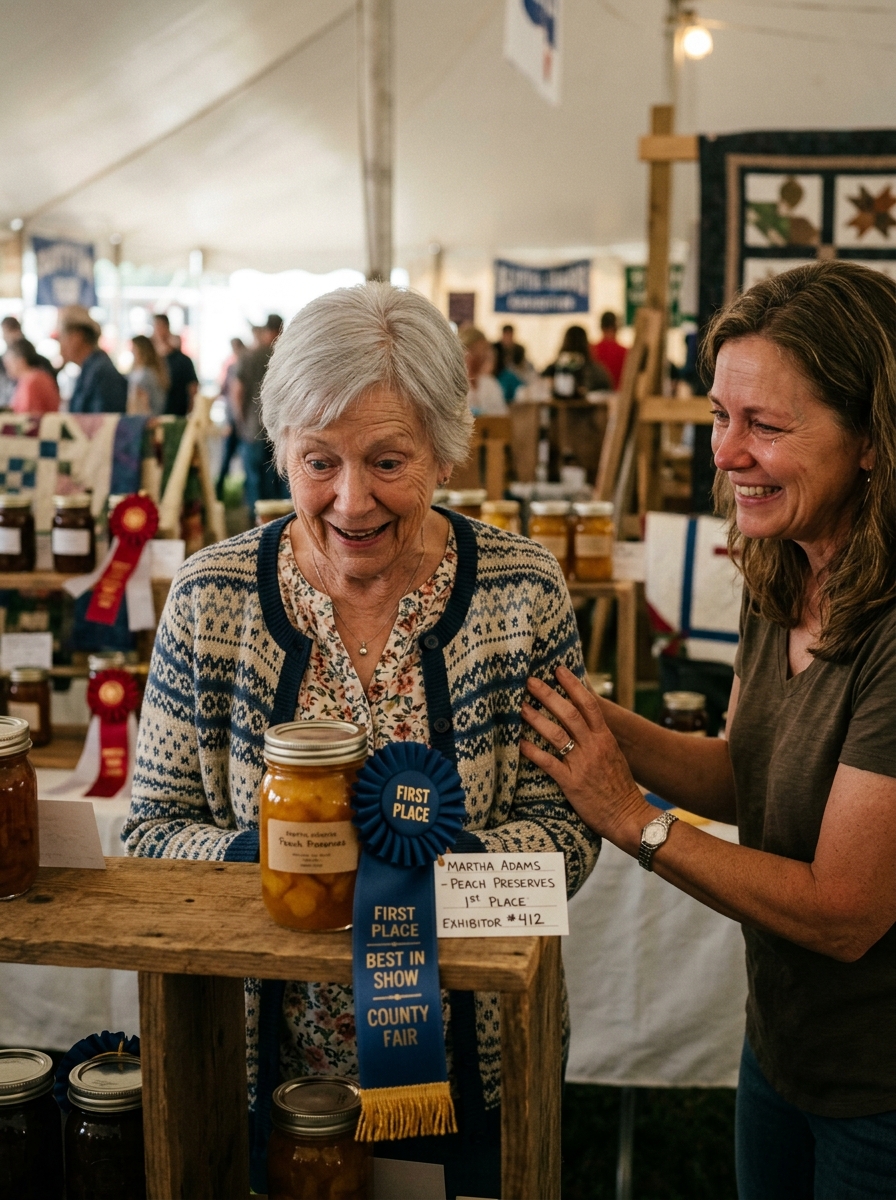
As the decades slipped past, the farmhouse across the lane changed hands twice, my own hair turned completely silver, and my knees began to ache whenever the weather turned damp before a thunderstorm. Canning became less of a daily necessity and more of a quiet, stubborn ritual—a way to honor the skills my own grandmother had passed down to me. Last month, during the humid rush of the annual county fair, I decided to enter a single quart of my spiced peach preserves into the home-arts pavilion, mostly just to see if my recipe still held up against the younger generation’s fancy organic jams. On a Thursday afternoon, leaning heavily on my wooden walking cane, I shuffled into the crowded canning tent under strings of colored paper flags and the rich smell of vinegar and sugar. My eyes scanned the rows of gleaming glass jars resting on the blue-clothed exhibition tables until they landed squarely on the center display stand. There, resting beneath a shiny brass rosette, the first-place blue ribbon was pinned proudly to a jar of peach preserves.
PART 3
I stepped closer, adjusting my spectacles to read the small white handwritten index card tucked beneath the ribbon. The neat, precise cursive caught my attention instantly—it wasn’t the flowing script of the local extension office judges. The card read: *Blue Ribbon Winner—Spiced Peach Preserves. Recipe learned from a kind farm wife named Ruth, the summer my mama died.* A sudden, sharp ache blossomed in the center of my chest, taking my breath away as the years evaporated in a single heartbeat. Those small, quick hands I had watched peel peaches forty-five years ago had somehow grown up, remembered the rhythm of my kitchen, and carried that quiet legacy out into the world.
I was standing there frozen, staring at the cursive lettering while the hum of the fairground buzzed around me, when a soft rustle of fabric sounded beside my shoulder. A woman in her late fifties, wearing a simple linen blouse and carrying a woven canvas tote bag, stepped up to the table to adjust the ribbon on the winning jar. She turned her head, caught my gaze, and hesitated for a fraction of a second as her eyes searched my weathered face. Then her expression shifted from professional curiosity into an absolute, radiant wave of recognition. She didn’t wait for me to speak; she reached out, touched my trembling arm with fingers that still possessed that familiar, gentle swiftness, and whispered my name across the crowded exhibition table.
ENDING
The forty-five years of silence between us dissolved right there beside the ribbon-winning preserves, replaced by tears and a long, fierce embrace that made the judges at the neighboring pie-baking table turn around to smile. Clara—now a grandmother herself, a culinary arts instructor at the regional vocational school, and a mother who had kept every single lesson she learned in my kitchen alive in her heart—stayed with me for the rest of that fair day, walking arm-in-arm through the livestock barns and sharing funnel cake like two old friends making up for lost time. Today, a framed photograph of Clara standing beside me on my front porch sits proudly on my mantelpiece right next to her blue-ribbon certificate. Whenever I look out across the gravel lane where the old maples still drop their leaves every autumn, I am reminded that love and kindness sown into the quiet moments of someone’s darkest hour are never truly lost—they simply wait patiently for the right season to bloom.