The paper edge kept catching on my thumb. My dad was standing beside my hospital bed, holding the envelope open while my mother-in-law reached for it. My daughter was asleep in the bassinet. Wyatt had finally stopped tapping his phone, but he still hadn’t said a word.
I didn’t know what was in the envelope yet. I only knew my dad looked more tired than angry, and he’d just said, “Good. I won’t feel guilty now.” That was not a sentence I’d heard him use before. I looked down at the papers, then at Marcia, and I knew that $620 wasn’t the real reason he’d come in holding them.
Four years earlier, I met Wyatt at a birthday get-together in Columbus. I was twenty-nine, working as an operations coordinator for a regional healthcare network. He sold medical devices and could make small talk with anybody. He brought me an iced latte one morning after I’d worked late, remembered I hated cinnamon, and seemed pleased when he got the order right.
I was not looking for trouble. I thought I’d found a decent man who could make a hard day feel less hard. That sounds plain, but I was tired of dating men who treated basic kindness like a favor. Wyatt was funny, warm, and good at looking like he was listening.
Marcia asked about my salary at our first dinner. She also asked whether I cooked from scratch and how long I planned to keep working once I had kids. I remember trying to turn it into a joke because the dinner had barely started.
“Well, at least you have a steady fallback,” she said. “Wyatt needs somebody who can support his ambitions.”
Wyatt laughed into his drink. I laughed too, because I didn’t want to make the whole night awkward. Dad later asked me how dinner went, and I told him, “She’s just old-fashioned.” I said it like I knew that was true. I didn’t.
After the wedding, Marcia started dropping by most weekends. She’d open the fridge, move things around, and ask why we’d ordered dinner instead of cooking. If Wyatt left a plate in the sink, she’d look at me as if I’d put it there to test her.
“Wyatt works hard,” she’d say. “He shouldn’t have to come home and do everything.”
“I work full-time too,” I told her once.
She gave me a small smile. “I’m sure you do.”
Wyatt always found a way to step out of it. He’d look at me after she left and say, “That’s just Mom. She doesn’t mean anything by it.” I accepted that for a long time. I also liked being the one who could keep the peace, which is not always the same as being kind.
We tried for a baby for almost a year. When I saw the two pink lines, I cried so hard Wyatt asked if something had happened. He pulled me close, kissed my forehead, and said, “We’re going to be great parents.” I believed him. I wanted to believe him.
For a while, he seemed excited. He helped choose a crib and spent a Saturday putting together the nursery dresser. He kept the little Allen wrench in the kitchen junk drawer, and I found it months later when I was looking for a twist tie. For some reason, I remember that stupid wrench better than the color we painted the room.
Then the gaming took up more space. Wyatt had always played with friends a few nights a week, which didn’t bother me. But it turned into whole weekends, and he bought a new computer setup, a special chair, and headphones he said he needed for his leagues. I was going to prenatal appointments alone and using lunch breaks to compare car seats.
At the anatomy scan, I asked him twice to come. The first time he said work was too busy. The second time, he said he’d try. That night, I found out he’d taken personal time to play in an online tournament.
“You told me you couldn’t get away,” I said.
“I couldn’t get away from work.”
“You weren’t at work.”
He rubbed both hands over his face. “I’ve been getting ready for this bracket for weeks.”
“I’ve been waiting weeks to see our baby.”
He apologized. Then he did something close to the same thing two weeks later. I told myself I was making too much of routine appointments. Marcia said, “Men don’t get worked up over every doctor visit, Tessa.” I stopped asking her to understand.
Around my seventh month, Dad called me about a credit inquiry. He used to work in bank fraud, and he still checked his credit reports like some people check the weather. I didn’t think much of it at first. He asked if I’d applied for a store card I didn’t recognize. I hadn’t.
I checked my own report and found two accounts I couldn’t place. One was a retail credit line. The other was a personal loan. I had no idea what to do with the information, so I did what I’d always done when paperwork felt too big: I told myself I’d deal with it after the next appointment.
Dad didn’t let me drop it. He asked if I wanted help disputing the accounts. I said yes, but I also asked him not to call Wyatt yet. I wanted to be certain before I started a fight I couldn’t take back. That was my call. It was not a good one.
Dad helped me freeze my credit and send the dispute forms. I had to give him permission to speak with the lenders, then wait for records to come back. We kept it quiet for a few weeks. Dad called now and then to ask if I’d received anything in the mail. I kept saying no.
By then I was tired all the time. My back hurt, my ankles were swollen, and my OB said I might need extra recovery time after delivery. I started saving for a private postpartum room. It cost $620 more than the shared room. I paid from my own savings, paycheck by paycheck.
When I mentioned it to Wyatt, he barely looked up from his phone.
“Whatever makes you happy,” he said.
That was all I got. I took it as permission because I wanted one thing to be simple. The room wasn’t fancy. It had a hospital bed, a loveseat, a bathroom, and a little space for one person to stay overnight. After weeks of sleeping badly, it sounded like enough.
Labor started on a Monday afternoon and lasted nineteen hours. At some point after midnight, I asked Wyatt to hold my hand. He was on his phone.
“Please put that down.”
“Hold on. I’m in the middle of a match.”
“Wyatt, our daughter’s coming.”
He sighed, locked his screen, and took my hand. He held it until the nurse stepped out. Then I heard the game sounds again. I couldn’t make myself argue. I had other things to do, like breathe and get through the next contraction.
Chloe was born Tuesday morning. She was tiny and warm, with a little crease between her eyebrows. The nurse put her on my chest. I remember the smell of clean towels and that odd hospital soap, sharp like lemon cleaner. I cried into Chloe’s hair.
“She’s perfect,” I whispered.
Wyatt took a picture, sent it to Marcia, and looked back at his phone. When the nurse asked if he wanted to hold Chloe, he said, “I’ll wait until later. Let Tessa have her moment.”
I didn’t know what to say to that. I wanted him to want to hold her. Instead, I told myself he was overwhelmed. That was one of the ways I kept explaining his choices for him.
A few hours later, the nurse helped me into the private room. I was so tired I could barely follow what she was saying about the call button. Chloe fell asleep in the bassinet, and I thought I might get some quiet.
Then Marcia came in without knocking. She looked around before she looked at the baby.
“Why are you in a private suite?”
“I reserved it ahead of time.”
“How much did you spend?”
“Six hundred and twenty dollars extra.”
Her mouth tightened. Wyatt was sitting in a chair by the window, head bent over his phone.
“Mom, don’t start,” he muttered.
He didn’t look up. Marcia did.
“Do you know how hard my son works? You’re throwing his money away for a fancy room.”
“I paid for it from my savings.”
“You’re married. There’s no such thing as your money and his money.”
“I saved it from my paychecks.”
“Then you should’ve spent it on something useful.”
The nurse checking Chloe’s vitals looked toward the doorway. I felt embarrassed, though I hadn’t done anything wrong. My throat was sore from labor and I didn’t want Chloe waking up.
“Please keep your voice down,” I said. “She’s sleeping.”
Marcia waved that off. “Women have had babies in shared rooms for years. I had Wyatt in one, and I turned out fine.”
I turned to Wyatt. He was still holding his phone.
“Are you going to say anything?”
He let out a breath like I’d interrupted him. “Can you two drop it? I’m trying to focus.”
I had just given birth to his daughter. I was sore and shaking, and he was annoyed that we were making noise near his game. I looked at the pillow because I didn’t want Marcia to see me cry.
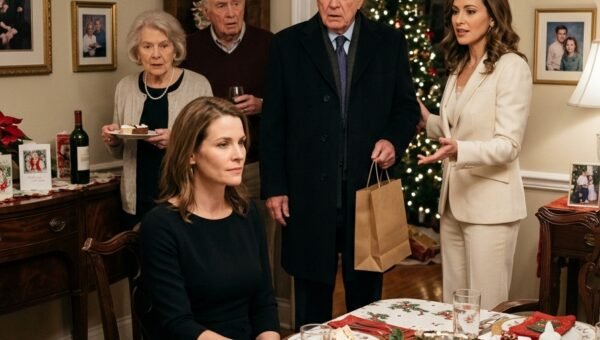
Then my parents came in. Mom had yellow roses and a thermal bag of chicken soup. Dad carried a gray stuffed bunny. Mom saw my face and stopped.
“Tessa, what happened?”
“Nothing. I’m tired.”
Marcia answered for me. “Your daughter decided she’s entitled to a luxury room on my son’s dime.”
Mom looked at me. “Didn’t you pay for it yourself?”
I nodded. Marcia kept going.
“It’s clear where she gets it. You raised a woman who expects her husband to bankroll every whim.”
Dad set the bunny on a chair. He didn’t raise his voice.
“Would you repeat that?”
Marcia turned to him. “What?”
“What you said about my daughter.”
She did. Louder this time. “You raised a spoiled daughter who expects my son to pay for her luxuries.”
Dad nodded once. Then he reached inside his coat and took out the white envelope.
“Good,” he said. “Then I won’t feel guilty about what I’m about to do.”
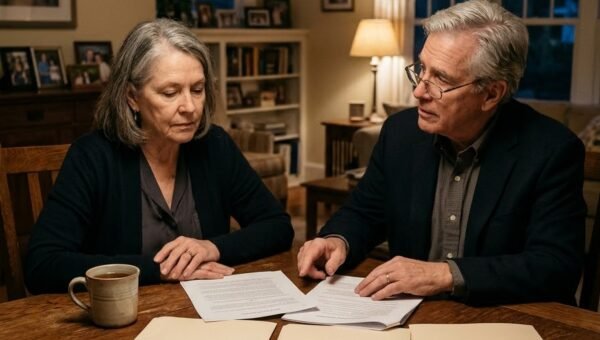
He put it in my hands. I had to use both because my fingers were still trembling. The envelope had my name on it in Dad’s handwriting. Inside were copies of the disputed account records and a letter from the lender.
I looked at the first page. One account had opened in my name, using my Social Security number and Wyatt’s email address. The second had my name on the loan line and his mother’s name listed as guarantor. The signatures looked careful. They were still wrong.
“What is this?” I asked.
Dad pulled a chair closer to the bed. “The accounts you disputed.”
Wyatt had stood up. “What did you do?”
“I didn’t do this,” I said.
He looked at me, then at the papers. “You said you were handling it.”
“I was. I didn’t know what it was yet.”
Marcia reached for the copy, and I moved it closer to my chest. She looked irritated, then confused.
“Why is my name on that?”
Dad answered before I could. “The lender sent the application after Tessa disputed the account.”
Marcia shook her head. “I never signed anything.”
Wyatt’s phone was in his hand again, but he wasn’t looking at it. “Mom, let’s talk about this later.”
“No,” Dad said. “We’re talking about it now.”
The envelope held more than the first pages. Dad had put the loan applications behind the account summary, along with the letters we’d received after the disputes. The lender had confirmed the retail account was opened from our home. The personal loan paperwork listed Wyatt’s email and a number ending in the same four digits as his phone.
I looked at him. “You told me you couldn’t afford to come to appointments.”
“I didn’t take your money.”
“You used my name.”
“It’s not like that.”
“What is it like, then?”
He rubbed the side of his jaw. “I was going to pay it back.”
Marcia stared at him. “You said Tessa was spending money from our account.”
“I said she was careless.”
“You told me you had to cover this room,” I said.
“I didn’t say that.”
Marcia snapped, “You told me she was using your money.”
He looked between us. For a second, I saw the same look he got when a game was going badly and he was waiting for the other players to fix it.
Dad kept his voice low. “The lender has both disputed accounts on hold. I’m taking the rest of these to the police after we leave.”
Wyatt took a step toward the bed. “You can’t do that.”
“I can,” I said. “And I will.”
I was surprised by how calm I sounded. I’d been crying a few minutes earlier, and my body still felt like it belonged to someone who’d run a race. But I knew I didn’t want him to touch the papers or turn this into another thing I had to soften for him.
Marcia sat down hard in the chair. She looked at the page again.
“I didn’t sign this.”
“I know,” Dad said.
She covered her mouth with her hand. I had no sympathy ready. Not then. She had just stood in my room and called me spoiled while I was holding a newborn. But I could see her name under mine, and I knew the feeling of finding something you never agreed to.
Wyatt started saying he could explain. He said the loan was temporary, the accounts were for equipment and bills, and he’d meant to tell me. He said he was stressed. He said he’d thought I wouldn’t understand.
I didn’t answer each excuse. I’d spent years trying to find the right wording so he would hear me. It had not helped.
Mom took Chloe from the bassinet when the nurse asked if I wanted to rest. Dad packed up the papers, leaving me the copies. Marcia stayed seated with her hands pressed together. Wyatt walked into the hall to take a call. He didn’t come back before the nurse came to check on me.
Dad filed the report that afternoon, with my permission. I gave the lender a written statement and changed my passwords from my mother’s house that evening. We kept the story to the facts. I didn’t tell the police that Wyatt had ignored me during labor. It felt too small beside the loan paperwork, though I knew it wasn’t small to me.
Over the next few weeks, the lender removed the accounts from my credit report while it reviewed the case. I stayed with my parents. Wyatt sent apologies, then angry messages, then apologies again. I saved them. I didn’t answer most of them.
Marcia called once. She didn’t apologize for the hospital room. She said she’d believed Wyatt when he told her I was taking advantage of him. I told her I understood what she was saying. I didn’t tell her that understanding wasn’t the same as forgiving.
The investigation didn’t wrap up in a neat little bow. The accounts were frozen, and the lenders had the paperwork. I filed for separation. Wyatt had to leave our apartment while the paperwork moved forward. I kept the gray bunny on the shelf by Chloe’s crib, though I never could remember which of us was supposed to have bought it.
I thought the worst part would be the first page, where my name sat beside a debt I hadn’t made. It wasn’t. Dad had kept the final page in the envelope until I was ready to read it. Marcia was still beside the bed when I turned it over.
Her name was under mine, and both signatures were in Wyatt’s careful handwriting.