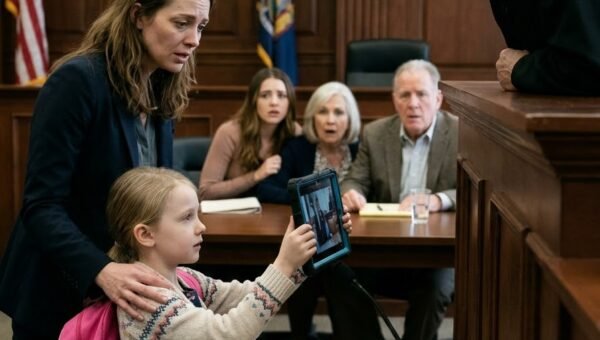
Eight years and eleven months after my daughter Keahu told me she was pregnant, I watched her read an invitation from the man who left her. She was standing by my kitchen counter, one hand on a pecan pie she’d brought over, the other holding her phone. I remember the pie because the crust had stuck to the foil and she kept picking at it with a butter knife. I remember that better than what I said. I should’ve had something useful to say.
Terrence Coleman had sent her a message asking her to come to his family’s Christmas dinner in Salt Lake City. The message said the family wanted to see her “one last time.” He thought Keahu had no children. He had never met the four she’d raised without him.
Keahu read the message again. I didn’t ask her what she was thinking. I already knew she was trying not to let him see that it had got to her.
I was the one who said, “You don’t have to go.”
She nodded, but she didn’t put the phone down. That was the first thing I should’ve paid attention to.
When Keahu was scared, she got very still and started doing little jobs with her hands. At twenty-five, she’d scrubbed the same spot on my counter until I took the sponge away from her. Now she was picking at pie crust.
“You think he knows?” I asked.
“No,” she said. “That’s the whole point.”
I wish I could say I told her to ignore him and meant it. I didn’t. Part of me wanted to see Terrence have to look at the four children he’d pretended weren’t real. That isn’t a kind thing to admit, but there it is. I loved my daughter.
I also wanted him to feel one small piece of what she’d carried.
The last time I saw Terrence before that Christmas, Keahu was standing in my laundry room with her coat on and both hands pressed against her stomach. She had just told him she was pregnant. He called her a liar. I can still hear the dryer thumping a pair of my jeans while he said he wasn’t going to be trapped by a baby.
He filed for divorce before we knew there were four babies.
I went with her to one appointment after he left, then another.
I learned the waiting-room TV always had the volume too low, and that Keahu couldn’t drink the orange juice they gave her because it made her sick. She tried calling Terrence a few times. He changed his number. When his lawyer sent the papers, I wanted Keahu to fight harder. I told her not to give him the satisfaction of seeing her beg.
I meant to protect her. I also know I made the choice easier for him. When she stopped calling, I let myself believe that was the same as being done.
It wasn’t. We just got on with our days.
Keahu gave birth to Mason, Wyatt, Delilah, and Savannah. They were early, small, and loud enough to make the hospital nurse laugh. I held each one. I learned which baby settled when I rubbed his back, and which girl would only sleep if I had one finger under her palm.
Terrence didn’t call. He didn’t ask. Keahu didn’t tell the kids his name when they were little. She told them their father had left before they were born and that it wasn’t because of them. She answered their questions as they came, but she never made up a better story for him.
I did, sometimes. Not out loud, exactly. I’d catch myself thinking he must have been frightened, or young, or ashamed. Then I’d remember that he’d had eight years to pick up a phone.
Keahu built a life in Phoenix. She worked hard, then harder, and got into a job that took her from a small office to a much bigger one downtown. I was proud of her. I also knew that money didn’t make the night feeds easier, or make it less strange when one child asked why nobody in his class had a dad who lived in another state and never called.
When Terrence’s message came, the kids were eight. They knew his name by then. They knew I didn’t like talking about him, which was my fault. I’d get sharp when they asked. I’d say, “Your mother knows what’s best,” as if that answered anything.
Keahu did not get sharp. She told them the plain truth.
Their father had left when he learned she was pregnant. He’d never met them. She didn’t know if he wanted to.
Mason asked if they were going to meet him now. Delilah asked if he knew they were all four of them. Wyatt wanted to know if Terrence had the same eyes as his. Savannah sat on the rug and pulled one of the loose threads on her sock until I made her stop.
Keahu told them she hadn’t decided. I watched her check their faces, one by one, and could see her counting the ways a bad answer might hurt them.
The invitation stayed on her phone for two days. She didn’t answer right away, but she didn’t delete it either. Then Terrence sent another message. This one asked her to come alone. He said it would be easier if they could talk privately.
That was when Keahu showed me the screen.
“He still thinks I’m on my own,” she said.
I was mad at him. I was mad at her for caring what he thought. Mostly I was mad at myself for still wanting to see his face when he found out. So I asked what she planned to do.
She said she’d go. She would bring the children. She would tell Terrence the truth in front of his family, because he had told his family his version for years and she was done letting them think she had simply vanished.
I said I’d go too.
She didn’t say yes at once. She looked at me like she was checking whether I’d turn the whole thing into my own fight. I understood that look. I’d done it before, even when I thought I was helping.
“I’ll stay out of your way,” I told her.
“You can come,” she said. “Just don’t make promises for me.”
I said I wouldn’t. I meant it as much as I could.
We flew from Phoenix on Christmas morning. Keahu had chartered a helicopter to get us up to Salt Lake City, which was more than I’d ever have spent on a trip, but she said she wanted to get the kids there and back without losing a whole day to airport lines. I didn’t argue. There were four children and a complicated family waiting at the other end.
Mason sat near the window and kept asking how long it would take to see snow. Savannah was holding a packet of crackers in her lap, and every so often she’d offer me one, even though I’d already said no. I took the last one because she’d kept trying.
Keahu looked out the window most of the way. She told the kids there wasn’t a right way to feel about meeting their father. She said they could leave if they didn’t like how things went. She told them she’d be beside them.
I was glad she said it. I was not glad that she had to say it at all.
As the helicopter came down, I saw the house and the snow on the lawn. I remember thinking the yard looked too neat for four children to run through. Then the engine noise softened, the door opened, and the cold air got into my coat.
Keahu climbed out first. Mason followed her. Then Wyatt, Delilah, and Savannah. They didn’t rush. They gathered close, all four in their matching holiday clothes, looking at the house where their father had lived without knowing they existed.
I stayed behind them. I wanted to reach for Keahu’s arm, but I didn’t. She had told me not to make promises for her. I figured I should start by not taking over the walk to the front door.
Terrence’s mother, Lorraine, opened it. She looked at Keahu first. Then she saw the kids. Her mouth opened, but no words came. I don’t know if she’d been told Keahu never had children, or if she’d just assumed that after all these years. I never got the chance to ask before the room started moving around us.
Terrence was standing by the dining room. He was heavier than I remembered, with more gray in his hair. A blonde woman in a red dress stood beside him. I took her for his fiancée because of the ring on her hand and the small open box near his plate.
The children looked enough like Terrence that nobody needed Keahu to explain the connection. Same heavy brows. Same stubborn chin. I don’t know how else to say it. Even I noticed it before I was ready to.
Terrence looked at Mason, then Wyatt. He looked at Delilah, then Savannah. The ring box slid from his hand and hit the table.
His fiancée asked who the children were. Terrence didn’t answer.
Keahu walked in. She had Savannah’s hand in hers. Her voice was steady, though I knew what it cost her.
“Merry Christmas,” she said.
No one answered her.
She introduced the children by name. Mason. Wyatt. Delilah. Savannah. She didn’t raise her voice or tell Terrence he was a bad father. She just let the names sit there, one after another, while he stared at them.
Then she said, “These are the children you never knew you had.”
I saw Lorraine put one hand over her mouth. The fiancée took a step away from Terrence. I saw myself looking at Keahu instead of at him, and I knew I was doing the thing I’d promised not to do. I wanted to step between her and the whole room. I made myself stay where I was.
Terrence found his voice at last. He asked if the children were his.
Keahu said yes. She said she had the hospital records, and they could do a DNA test if he needed it. She didn’t say it like a dare. She said it like a fact she’d had to carry by herself.
His mother asked why she had never told them. Keahu looked at her for a moment.
“I tried to tell Terrence,” she said. “He called me a liar.”
Lorraine looked at her son. Terrence stared down at the table.
I wanted to say that I’d been there when Keahu tried. I wanted to tell Lorraine how many times my daughter had sat at my kitchen table with the phone in her hand and then put it down. But Keahu was answering for herself, and I didn’t need to turn her hurt into a speech.
The fiancée picked up the ring box and set it down again. She asked Terrence if he’d known Keahu was coming with the children. He said no. She asked if he had known about the pregnancy when he left. His face tightened.
He said he’d thought Keahu was lying.
That was the one sentence that stung worse than I expected. Not because it was new. Because he was still talking about what he had thought, while four children stood there with their coats on.
Keahu asked if he’d told his family she had chosen not to have children. He said he had told them they weren’t together anymore. It wasn’t an answer. Lorraine said he’d told her Keahu had moved on and didn’t want any contact.
The room got quiet again. I could hear one of the kids rubbing a sleeve between his fingers. I don’t know which one.
Keahu didn’t look at me. She told Terrence that the children didn’t owe him a hug, or a good mood, or a chance to act like nothing had happened. He said he understood. He looked as if he wanted to say something else, but he didn’t.
Then Savannah asked if he was their grandpa.
It was a small question. She asked it the way she might ask if there was juice on the table. Terrence didn’t answer right away. Lorraine started crying without making much noise.
I saw Keahu’s hand tighten around Savannah’s. I nearly said something. I didn’t.
Terrence finally said he was their father. He said he wanted to know them, if they’d let him. The kids looked at their mother. She told them they didn’t have to decide that day.
That was when the visit could have turned into a family scene. Lorraine was already asking about their birthdays. Terrence started to ask about school. His fiancée had backed away from the table and taken the ring off her finger. I could feel the children getting pulled into all the grown-up feelings at once.
Keahu stopped it.
She said they had come because Terrence had invited her to dinner. She hadn’t promised the children a relationship with him, and he hadn’t earned one by looking surprised. If he wanted to meet them again, he could start by writing to them. Then he could wait for their answer.
Terrence nodded. He didn’t argue. I gave him that much.
I also hated that I felt relieved when he didn’t argue. The bar was so low that one quiet nod felt like good behavior. I’ve thought about that more than I wanted to.
The dinner went on, but not like the dinner Lorraine had planned. Keahu let the children sit at the table for a while. I sat beside them and passed the rolls. Terrence sat across from Mason and kept asking gentle questions. Mason answered one or two, then went back to his potatoes.
Lorraine kept bringing up little pieces of Keahu’s childhood. She asked if Keahu still hated mushrooms. Keahu said she did. That was the first time they’d talked like mother and daughter in years, though Lorraine had been her mother-in-law, not her mother. I watched both of them try to figure out how to speak without crossing a line.
The fiancée left before dessert. She didn’t make a scene. She said she needed some air, and Terrence followed her to the porch. I didn’t ask what happened between them. I had enough trouble keeping my own attention where it belonged.
When he came back in, his eyes were red. He asked Keahu if he could write to the kids. Keahu said he could send a letter to her address. She’d read it first, and the children could decide whether they wanted to read it too.
I thought that was fair. I also wanted to tell him he didn’t deserve even that. Both things were true.
We left before dark. Lorraine hugged the kids only after they said yes. She hugged Keahu too, but Keahu held herself stiff for most of it. I know that because I stood close enough to hear Lorraine whisper that she was sorry she hadn’t called.
Keahu said, “I know.”
She didn’t say it was all right. I was proud of her for that.
A week later, Terrence sent a letter. It was short. He didn’t ask the children to forgive him. He said he’d been wrong to call Keahu a liar and wrong to leave without finding out the truth. He wrote each child’s name at the top of a separate page, even though the words underneath were nearly the same.
Keahu read them first, just as she’d said she would. She asked the kids if they wanted to hear the letters. Mason said yes. Wyatt said he didn’t. Delilah wanted hers read twice. Savannah folded hers in half and put it in the drawer with her school papers.
The DNA test came later, after Keahu and Terrence agreed on how to do it. It confirmed what we already knew. He was their father. He didn’t ask to take them away or claim he’d been part of their lives. The paperwork gave him a fact. It didn’t give him eight years back.
He started by writing. The kids answered when they wanted to. He visited Phoenix the next spring, and Keahu stayed in the room the whole time. I went too, though I sat in the kitchen and tried not to listen.
I had wanted the Christmas dinner to make him hurt. That was the part I carried into the room with me. Instead, I watched my daughter give him a narrow, careful chance because the kids wanted to decide for themselves. I’m glad she was better than me at that.
We still have the invitation. Keahu kept it in the kitchen drawer, under the takeout menus and the rubber bands. The message said the family wanted to see her one last time. Terrence meant it as a small ending, I think. He didn’t know he was inviting the four children he’d left behind.