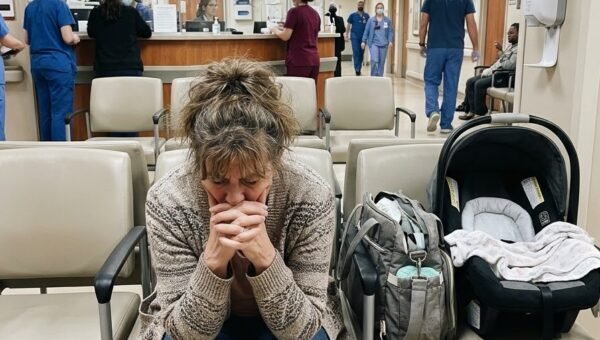
I was scraping dried coffee grounds out of the filter when I asked Michael what he’d signed in 2008. He was at the kitchen table, sorting the mail into piles like he did every morning. I set the ultrasound report beside his hand. He didn’t pick it up.
“What did you sign?” I asked.
His fingers stopped on a grocery flyer. “Susan, don’t do this.”
I’d spent eighteen years telling myself I had no right to ask him for anything. That morning, I asked anyway.
The doctor had seen something on my scan that didn’t fit the story I’d been living with. She said I needed to go home and ask Michael what happened during my hospital stay. I’d gone home with the question tucked under my arm like a bill I couldn’t pay. Now I was waiting for his answer.
He looked older than he had when I first saw him in that hospital room. I was, too. There was a little coffee stain on his sleeve, and I remember thinking I should tell him. That’s the sort of thing I used to notice instead of the bigger things.
“I don’t know what you mean,” he said.
I slid the report closer. “Then read it.”
Michael pushed his chair back. The legs scraped the floor. “Not now.”
That was the first time in years I didn’t let him end the conversation by walking away.
In 2008, I had an affair. I’m not going to make it sound smaller than it was. I lied to Michael’s face, more than once. I was lonely, and I was angry about being lonely, and I used that as a reason to do something selfish. Those things can all be true at the same time.
The man I was seeing worked with a crew from another town. I won’t name him. He doesn’t matter much to this part. Michael found out because I left a message on the kitchen phone and forgot it had saved the number. I can still hear the machine click off after the message ended.
Michael didn’t shout. He sat at the kitchen table with his hands folded and asked, “How long?”
I told him.
He asked, “Was it only him?”
I said yes. It was, as far as that question went.
He didn’t throw a plate or call me names. He just stood up, rinsed his coffee cup, and went upstairs.
I remember the tap running after the cup was clean. I stood there with my hands flat on the counter, waiting for some big reaction that never came.
For a while, I thought the quiet meant there was still a chance. I kept making his coffee. I kept asking if he wanted eggs. I kept leaving the hall light on because he used to come downstairs for a glass of water at night.
He never came down for water.
Our son, Jake, was twelve. Michael and I agreed not to tell him the whole story. We said we were having problems. I told Jake that grown-ups sometimes needed space. I thought I was protecting him. I was also protecting myself from seeing what my choice had done to the people in my house.
Michael stayed. He paid his share of the mortgage, fixed the loose latch on the back gate, and brought in the trash cans every Friday. He still went to Jake’s school events. From the road, our place looked like any other home on our street.
Inside, Michael moved into the main bedroom and I took the small room at the back. I didn’t ask how long it would last. The answer might have been forever, and I didn’t think I could stand hearing it said out loud.
The first winter, I tried to talk to him at dinner.
“I can sleep somewhere else,” I said, though I already was.
He looked at his plate. “You are somewhere else.”
I had no answer for that. I ate my potatoes and told myself it was fair.
That became the rule I used to explain everything. If he didn’t sit next to me on the sofa, I’d earned it. If he gave me his birthday card without a hug, I’d earned it. If he pressed himself against the hall wall so we wouldn’t brush shoulders, I’d earned that, too.
I’m not proud of how neatly I made it work for him.
On holidays, I arranged things so Jake wouldn’t have to see us argue. We set out the plates together. We took the same picture every Christmas, with Michael on one side of Jake and me on the other. In the photos, we look like a family. That’s what people said, anyway.
Jake stopped believing that before I did. When he was in middle school, he came into the kitchen while I was folding dish towels.
“Why doesn’t Dad sit by you anymore?”
I had a towel in my hands. One corner was frayed, and I kept picking at the loose thread.
“Marriage changes,” I said. “People get older.”
He looked at me for a second. “That’s not what I asked.”
I told him to finish his homework. He did. I never went back and answered.
By the spring of 2008, the guilt had worked its way into everything. I wasn’t sleeping much, and I had quit eating meals with any regularity. I’d take a few bites and say I’d already eaten. Michael didn’t ask. I didn’t ask him to.
One night I swallowed more sleeping pills than I meant to. I don’t remember counting them. I remember sitting on the edge of my bed with the bottle in my hand, thinking I wanted everything to stop for a little while. I know that sounds like a line people use after the fact. It’s what I thought then.
When I woke up in the hospital, my throat hurt, and my stomach felt scraped raw. There was a deep ache low in my abdomen. The clock on the wall read 4:18. I remember because I kept staring at the red numbers.
Michael was sitting beside the bed. He had my hand in both of his. It was the first time he’d touched me in weeks, and I was so grateful I didn’t ask why.
“Don’t worry,” he said. “The pain’s from them pumping your stomach.”
I believed him.
I don’t remember the nurse’s name. I remember the dry paper under my arm and the little plastic cup of water that tasted like the sink. I remember Michael saying he’d called Jake’s school and told them I was sick. I remember thinking, at least one of us had managed to keep things together.
The next few days are broken up in my memory. I was tired. I had a headache. I went home to the back bedroom, and Michael brought me toast once. He set it on the nightstand and said, “Try to eat a little.”
I said, “Thank you.”
That was as close as we got to talking about the hospital. I didn’t ask about the pain. I didn’t ask what the doctors had done. He said it was from the treatment, so I accepted that. At the time, I was relieved to have a reason that didn’t require a conversation.
I had a follow-up appointment. Michael drove me. I don’t remember what the doctor said, and I can’t find a record of that visit now. Maybe I didn’t go in alone. Maybe I did. I’m not sure, and I hate that I’m not sure.
Weeks passed. Then months. I learned how to live around the closed bedroom door. Jake learned not to ask questions at dinner. Michael went on making coffee every morning, and I went on scraping grounds out of the filter. It was an ordinary job, and ordinary jobs kept the day moving.
The years didn’t feel like one long punishment while I was living them. They felt like a lot of small days. I worked at the elementary school office until I retired. I paid bills. I helped Jake get through high school. I baked a cake for his graduation, and Michael took pictures from the end of the table.
When Jake left for college, the house got quieter. Michael and I still ate in the same kitchen, but we didn’t eat together every night. He’d sit down after I’d finished, or I’d leave a plate covered on the stove. The arrangement became so regular I stopped noticing that it was an arrangement.
I should say I tried to leave once. Not in a serious way. I packed a duffel bag and put it by the back door after a fight about a broken water heater. Michael said, “You can go if you want.”
I sat on the bed for a while. Then I unpacked the bag.
I told myself I stayed because I didn’t want to uproot Jake. He was already grown by then. The more honest reason was that I didn’t know who I was if I wasn’t the guilty one in our marriage. It was a bad reason to stay. I stayed anyway.
Jake got married. Michael and I sat through the ceremony, then stood beside each other for the family pictures. Someone told us to move closer. Michael put his arm around Jake, not me. I smiled at the camera and went home with the little paper program folded in my purse.
At retirement, I had more time to notice things. The house needed work. My hips hurt if I sat too long. I had that dull pressure low in my abdomen, on and off for months. It wasn’t sharp. It wasn’t bad enough to send me to the doctor, which is what I told myself.
Eventually I booked a physical with Dr. Evans. I was sixty-two. I gave her my medication list and told her about the pressure. She asked when it started. I said maybe the year before, but I couldn’t swear to it.
She ordered a pelvic ultrasound.
The sonographer was quiet during the scan. I knew that wasn’t a sign of anything by itself. I’ve had tests before. Still, I kept watching the ceiling and listening to the little squeak of the paper under my hip.
Afterward, Dr. Evans came in and shut the door.
“Susan, have you ever had surgery?”
“No.”
She looked down at the screen, then back at me. “Not even in 2008?”
I felt the table paper crackle when I sat up. “No. I was hospitalized after an overdose, but they pumped my stomach.”
She didn’t answer right away. She turned the monitor toward me. I didn’t know what I was looking at, except that she had pointed to a place and there were two small bright marks on the screen.
“I can’t tell from this alone what happened,” she said. “But there are signs of a past procedure involving your fallopian tubes.”
I said, “That can’t be right.”
She said, “I’m not making a claim about how or why. I want the hospital records.”
The clinic had my old medical history in its system, but the hospital had changed names twice since 2008. Dr. Evans helped me request the records. I signed the release form at her desk, then sat in my car for ten minutes before starting it.
I wanted to call Michael. I also wanted to go home and pretend I hadn’t seen the marks on the screen. I was good at choosing the second thing.
The hospital records took twelve days. I know because I checked the mailbox before work each morning, even though I’d retired. I called the records office twice. The second time, a woman told me the file had been sent and said, “It should be there today.”
It came in a thick envelope with a return address from the hospital system. I set it on the kitchen counter beside the coffee filters. I didn’t open it until Michael left to pick up a prescription.
Inside were discharge notes, medication lists, and pages about my overdose. I read them in order. Some of the handwriting was hard to make out. I had to use a magnifying glass from the junk drawer.
The procedure was listed on one page: laparoscopic tubal ligation.
I read it once. Then again.
There was a consent page in the file. My name was printed at the top. The signature at the bottom was not mine.
Michael’s name was written on the line for the person giving consent.
I called Dr. Evans. She told me to bring the records in and not to assume what the page meant until we had the full chart reviewed. I appreciated that. I also wanted her to tell me there was some explanation that would make it all ordinary.
There wasn’t.
The chart said I was medically stable. It said I had been awake at times, though I didn’t remember that. The procedure wasn’t described as an emergency. There was a note saying my husband reported that I had previously asked for permanent birth control and that I had “no objection” to the procedure.
I didn’t remember asking for it. I had never wanted it. I was forty-four, and Jake was our only child. I had never even had my tubes tied.
I asked Dr. Evans if the hospital could have done it without my consent.
She didn’t dress it up. “The records need a full review. This consent page doesn’t show that you signed it.”
I took copies home. I could have called a lawyer that afternoon. Instead, I put the papers in a manila folder and waited until Michael was back from the store.
I waited because I was scared of hearing him say it was true. I waited because part of me still thought I needed to be fair to him. I waited because I was tired, and it was easier to let the kettle boil than start a fight I couldn’t put away.
Then the coffee was dripping, and I asked.
Michael came back to the kitchen after stepping away from the table. He looked at the folder. “Where did you get that?”
“The hospital.”
He sat down slowly. “You don’t know what you’re reading.”
“I know I never had surgery.”
“You were very sick.”
“I know I was.”
He pressed his thumb against the edge of the folder. “You were asleep. I had to decide.”
“What did you decide?”
He looked at the counter instead of me. “You were seeing somebody else. I didn’t know what else was going on.”
“I was having an affair,” I said. “That was my choice. You had no right to do this.”
He rubbed his face. “I thought it was best.”
“Best for who?”
He didn’t answer.
I asked him if I’d ever said I wanted the procedure. He said he thought I had. I asked when. He said he couldn’t remember. I asked if he’d told the hospital I’d agreed. He said, “They asked me what you wanted.”
“Did they ask me?”
He looked down. “You weren’t in any shape to talk.”
“So you answered for me.”
He made a small move toward the folder. I put my hand over it.
“Don’t,” I said.
He pulled his hand back. The coffee maker clicked off behind us. Neither of us reached for the pot.
Michael told me he’d been afraid I’d get pregnant. He said he was afraid the baby wouldn’t be his. He said he couldn’t live through that kind of humiliation again. He spoke quietly, not like a man trying to win an argument. More like a man laying out the reasons he’d repeated to himself until they sounded like permission.
I listened. I didn’t tell him the reasons were good. I didn’t tell him they were enough. They weren’t.
“What did the doctor tell you?” I asked.
“I don’t remember.”
“Did you sign that page?”
He stared at the table. “Yes.”
I had spent eighteen years making excuses for him because I had spent eighteen years making excuses for myself. I had hurt him. That didn’t mean he got to make a permanent choice about my body while I was unconscious.
I called Dr. Evans from the kitchen. I told her Michael had admitted signing. She gave me the number for the hospital’s patient advocate and said I could also talk to a lawyer. I wrote both numbers on the back of a grocery receipt.
Michael left the room while I made the calls. I didn’t chase him. I didn’t ask him to come back. I told the patient advocate what I knew and sent copies of the records. She opened a review. A lawyer later helped me get the full chart and file a complaint with the state medical board. The hospital acknowledged that the consent record did not show my agreement. They didn’t give me back the choice I should have had, but they did put in writing that the chart had been handled improperly.
I filed for separation that fall. The house was in both our names, and neither of us wanted a long fight over it. We agreed to sell it and split what was left after the mortgage. Jake was upset, then quiet, then upset again. I told him the short version and didn’t ask him to take my side.
Michael and I sat across from each other at a lawyer’s office and signed the papers. We didn’t yell. We had already done enough years of not saying what we meant.
When I got home, I made coffee in the old kitchen for the last time. I scraped the grounds out of the filter and dropped them in the trash. I didn’t leave a second cup waiting for Michael.
He stood by the table with the signed papers in his hand.
“I’m sorry,” he said.
I believed he was sorry. I also knew sorry didn’t give me back the years, or the choice, or the chance to answer for myself.
“I know,” I said. “But I’m not staying.”
Then I put my copy of the consent form in my purse and walked out of the house.