The court judgment kept catching on the zipper of my work bag while Barbara handed me the dirty plates. I could feel the corner of it through the canvas as I took the stack from her. Nate was telling a story to his regional director beside the grill, and nobody there knew that nine months earlier, according to a judge, Nate and I had divorced. I didn’t know it either. I set the plates down in the trash, and the crash stopped his story.
I’m going back because the order matters. At the time, I didn’t know who had signed the papers for me. I just knew the banker had shown me a court judgment and a statement for fifty million dollars, both with my name on them. I’d gone in expecting routine trust paperwork. I came out with the wrong number in my head, the one that made every other number feel suspect.
I was thirty-three then, a supply chain manager outside Chicago. Most of my job was finding the one wrong number that could hold up a whole warehouse. I was good at that.
At home, I had spent years explaining away numbers that didn’t add up.
Nate sold enterprise software. He drove a leased Porsche and was the kind of person who remembered a server’s kid’s name after hearing it once. For a while, I thought that was just who he was. He could make people feel like old friends. I liked that about him, even when it meant he was still talking to someone when I wanted to leave.
I paid most of the regular household bills. The mortgage, taxes, and insurance came to just under four thousand dollars a month, and my paycheck covered them. Nate said sales commissions were unpredictable.
“Your paycheck keeps us steady,” he’d tell me. “Mine gets us ahead.”
I accepted that because I wanted to believe we were a team. His money was supposedly building our future. I didn’t ask to see the accounts. I’m not proud of that. I liked being the person who kept things moving, and I treated questions like they were a sign I didn’t trust him.
When Barbara called Nate a wonderful provider, he never corrected her. I noticed. Then I told myself correcting her would be awkward, and anyway it wasn’t worth a fight.
I can make a whole list of small excuses now. Back then I could make one in about half a second.
My uncle died that spring. We weren’t close. I saw him at a few family events, and once he sent me a card with a check for $200 when I finished college. When his attorney called, I expected some papers and maybe a small bequest. I didn’t expect an inheritance that would make the banker read the amount twice.
The trust was meant for me. Fifty million dollars. I called Nate from the parking lot after the meeting, then stopped before I hit his name. I’d wanted to tell him the whole drive there. We could pay off the house, take a breath, maybe finally plan something without checking the cost first. I had already asked the banker about putting part of it in a joint investment account.
That was my idea. Nobody had asked me to do that. I was already thinking like the money belonged to both of us.
The banker, Mr. Henderson, put a second folder beside the trust papers. I remember the little click when he shut his pen. He asked me whether I knew that a divorce had been entered in my name the previous July.
“That can’t be ours,” I said. “We’re married.”
He turned the folder so I could read the case number. The names and birth dates were right. The judgment was signed by a judge. Behind it was a property agreement with a signature that looked close enough to mine at first glance.
I leaned nearer. The bottom of the H was wrong. I have always written my H with the last line curling back. This one didn’t. It was a small thing, the sort of detail I’d notice on a packing slip without thinking. I looked at the other page. It said I’d agreed to live separately, disclosed my finances, and settled our property.
I had never lived at the address listed for me. It was Barbara’s house. I’d been there for Sunday dinners and Christmas, but I’d never had a key.
“I didn’t sign this,” I said.
Mr. Henderson didn’t tell me what to do. He said the bank couldn’t settle a court dispute and I needed my own lawyer. He also said he wouldn’t add Nate to any account or send him information without my written permission. I asked for copies of everything. Then I made him repeat the part about the account, because I needed to hear it once more.
I didn’t call Nate from the parking lot. I didn’t call him at all. I drove home with the folder in my work bag, kept both hands on the wheel, and tried not to decide what it meant before I knew the facts.
At home, the Porsche was in the driveway. There were voices behind the cedar fence, and the patio chairs scraping the concrete. I’d forgotten Nate was having colleagues over. I could have gone inside and waited. I actually stood by the back door for a few seconds, holding the bag. Then I heard Barbara say my name.
She was at the patio table. Nate stood near the grill with a beer, telling his regional director about a client who’d missed a deadline. The patio heaters were on, though it wasn’t very cold. One of them made a faint clicking sound I kept noticing all night.
“There she is,” Barbara said. “We were beginning to think you’d miss dinner.”
I said hello. One of Nate’s coworkers asked how my day had gone. I started to answer, but Barbara put a stack of plates in my hands.
“She wears herself out at that warehouse,” she said. “I keep telling her how fortunate she is that Nate can give her all this.”
She waved toward the house. I’d made the mortgage payment three days earlier. The number was $3,842.17. I didn’t need to remember it that exactly. I did anyway.
“Be careful with those,” Barbara said. “They’re not dishwasher safe.”
Nate heard her. I looked at him and waited a second, though I don’t know what I expected. He smiled at the regional director and went back to the story. There was a steak knife on top of the plates. I lifted it off and set it on the serving table, then walked over to the trash can.
The plates hit the bottom hard. Everyone turned. Barbara stared at my empty hands.
“Hannah. What are you doing?”
I put my work bag on a chair and picked up the open bottle of wine. I poured a glass. My hand was steady enough, which surprised me. I didn’t have a speech prepared. I had one plain sentence.
“Since Barbara says Nate provides all this, let’s drink to him taking over the bills I’ve been paying. Starting with his Porsche.”
Nate set his beer down. His mouth tightened. He glanced at his regional director, then at me.
“Hannah,” he said quietly. “What are you doing?”
I could have taken the folder out right there. I didn’t. I’d spent years letting Nate decide when something was a big deal and when I was overreacting. I wasn’t going to make the court papers into a party show, even though the whole thing was already a party show. I took one sip of wine and said I’d had a long day.
That was all. Barbara muttered something about me being tired. A coworker asked Nate about a project. The night kept going, but it wasn’t the same night anymore. I sat at the end of the table and let the folder stay in my bag.
Nate followed me inside when the guests were leaving. I was standing by the kitchen counter, looking at the envelope from the bank. He shut the door behind him.
“Why’d you say that out there?” he asked.
“Because it’s true.”
“You’re making it sound like I don’t contribute.”
“You let your mother say I’m lucky you pay for the house.”
He rubbed his forehead. “She didn’t mean it like that.”
I asked him if we’d gotten divorced. He looked at me for a beat too long, then said the court file must be wrong.
“Those things happen,” he said.
“Not with my signature on them.”
He asked to see the papers. I said no. That made him angry, but he didn’t shout. He said he’d talk to his attorney in the morning and sort it out. I told him I was getting my own attorney. He said that was unnecessary.
I said it plain. “I’m doing it anyway.”
I slept in the guest room with my work bag beside the bed. Not because I was scared of him. I wanted the papers where I could see them when I woke up. The next morning, I called a lawyer named Lynn who handled family cases and fraud. She told me not to sign anything, not to move money without advice, and not to let Nate take the documents.
The file had more than the judgment. It included a certificate saying I’d been served at Barbara’s address. It included an agreement giving Nate the house and stating I had no claim to his retirement account or other property. It said I’d appeared before a notary in June and acknowledged the agreement.
In June, I’d been in the hospital with pneumonia. I remembered because I’d kept asking Nate whether the mortgage payment had cleared. He’d brought flowers in a paper sleeve, and the room smelled like the lemon hand soap from the sink. I’d been tired and feverish and embarrassed that I couldn’t walk to the bathroom without help. Nate brushed my hair back and told me to stop worrying about bills.
“I’ve got it,” he’d said.
I didn’t think about that sentence much until I saw the date on the notarized page. Then I thought about it too much.
Lynn asked for my hospital records and the court’s service records. I also pulled up the old family calendar I kept in a desk drawer. It was one of those paper ones with a magnet on the back. I’d marked the hospital days in blue pen because I used to keep track of work deadlines that way. The date on the notarization was right there. I had been admitted the day before.
That didn’t prove who had signed the paper. It did prove I wasn’t at Barbara’s house. I kept telling myself there might be a clerical mistake. I wanted there to be. There was still part of me trying to protect the version of Nate who brought me flowers and remembered my coffee order.
Lynn asked whether Nate had any reason to get the house into his name. I said not that I knew of. Then I remembered a conversation about refinancing. A few months earlier, he’d asked me where I kept my Social Security card and whether I still had a copy of the deed. He said he wanted to see if we could lower the payment.
I’d found the deed in the file cabinet and given it to him. I didn’t think to ask why he needed the original. I was busy with a warehouse inventory deadline, and I wanted to believe the question was normal.
Lynn checked the county records. The divorce judgment had been filed, but no deed had been transferred. There was also a loan application attached to an earlier title inquiry. Nate had tried to borrow against the house. The papers described him as the sole owner under the divorce judgment and asked for $214,600 in cash.
The application had not gone through. The title company wanted proof that the settlement agreement was valid. That request was dated seven weeks before my uncle died.
I looked at the amount for a long time. I didn’t know what Nate owed or what he planned to do with that money. I did know that my paycheck had paid the mortgage while he’d been trying to use the house as if it belonged only to him. One wrong number holds up the whole warehouse. This one had been sitting in my file cabinet.
Lynn said we could ask the court to set aside the judgment because I had not been served and had not signed the agreement. She asked if I wanted to call the police about the forged paperwork. I said I needed a day. That was me trying to make the decision easier by waiting, which never works as well as I hope.
Nate kept saying he would straighten it out. He said he hadn’t known what his lawyer filed. He said his attorney had handled the paperwork. When I asked for the attorney’s name, he gave it to me, then said he didn’t want this to get ugly.
“It already is,” I said.
He started sleeping in the spare room. A week later, he moved a few shirts and his laptop to Barbara’s house. He told me he needed space to think. I didn’t stop him. I did ask him not to take anything from the file cabinet.
“I’m not trying to take your stuff,” he said.
I didn’t answer. I’d heard that sort of line before, though not in those words. It used to mean I should stop asking.
Lynn found the notary’s name on the full court copy. It was Barbara. I knew she had done some paperwork for her church, but I didn’t know she was a notary. Lynn requested the notary journal through the court process. There was no entry showing that I had appeared before her. The signature line in the journal was blank.
Barbara had put her stamp on a paper saying I was there. I was in a hospital bed. The judge had been given a file that said I’d agreed to a divorce and signed away my claim to the house. I kept rereading that part, then checking the date in my paper calendar, as if one of them might change.
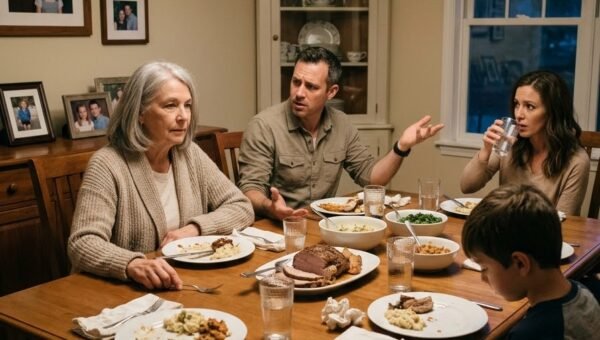
Lynn wanted to speak with Barbara before filing the next motion. Barbara agreed to meet us at her house. Nate wasn’t there. I sat at the end of her dining table, where I’d eaten Thanksgiving turkey six months earlier. Lynn placed the notary page and the journal copy between us.
Barbara picked up the page. She didn’t look at me right away.
“He said you wanted out,” she said.
“I was in the hospital.”
“I know.”
That was the line that stayed with me. Not because it was clever. It wasn’t. Barbara said it quietly, and then she stared at the paper.
“I thought he was trying to keep the house from going into foreclosure,” she said. “He told me you’d agreed to everything.”
“Did you see me sign it?”
She shook her head.
“Did you sign your name as the notary anyway?”
She said yes. Then she said she was sorry. She looked tired, and I could see that she believed Nate had given her a reason. I also knew she had chosen to help him make a lie look official. Both things could be true. I didn’t comfort her. I’d spent enough time making other people feel better before I knew what they’d done.
The court took months to set aside the judgment. Nate didn’t fight that part once the notary records and hospital dates were in the filing. He admitted the signature was not mine. He said he had been behind on bills and thought he could refinance the house before things got worse. He said the money would have covered debts and bought him time.
He did not say why he hadn’t told me. He did not have to. The answer was in the papers he’d filed. He wanted the house without having to ask me for it.
The judge vacated the divorce judgment. My uncle’s trust stayed in my name, and Mr. Henderson kept his promise about not sharing information with Nate. The title company stopped the loan application. I filed a police report, though I didn’t push for a public fight. Barbara lost her notary commission. Nate had to repay the legal fees that came from his false filing as part of our final settlement.
We got divorced for real about a year later. I kept my share of the house sale and paid off the mortgage. Nate took his Porsche lease and the debts he’d kept hidden. I used a lawyer for every part of it, including the part where I wanted to believe we could still talk it through over coffee. We couldn’t. I had wanted to be generous with the inheritance. I still don’t know whether that was love or an old habit of trying to make the room easier for everyone else.
The trust didn’t make the year simple. It made it possible for me to leave without pretending the house was fine. I bought a smaller place near work and kept one of the paper calendars in a kitchen drawer. I still write down appointments by hand. It’s not because I think paper is safer. I just like seeing the dates.
I don’t think Barbara was a monster. I think she wanted to believe her son, and then she put her stamp on a lie. I don’t think that makes what she did small. Nate said he was scared about money. Maybe he was. I was scared too, and I hadn’t tried to take his name off a house he paid nothing toward.
The first time I heard Barbara call Nate a provider after the court set the judgment aside, I didn’t correct her. I just left. My work bag was lighter by then. The corner of that old court copy wasn’t catching on the zipper anymore.