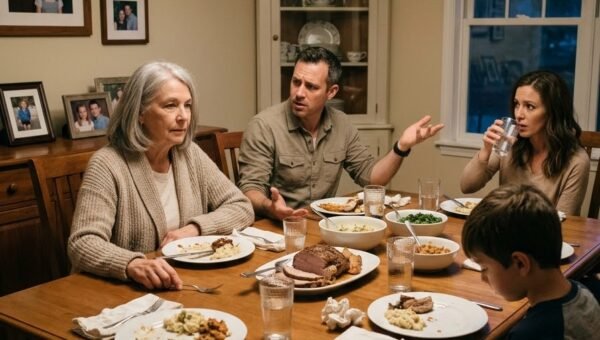
By the time I answered the seventh call, I was standing in the pantry with the folded grocery list still in my shirt pocket. I could hear the refrigerator running. Vanessa didn’t bother with hello.
“Your card was declined.”
“I know.”
“You know? You did this on purpose?”
“Yes.”
She went quiet for a second. I’d worked enough years around job sites to know when a conversation had reached the point where somebody was waiting for me to fix the thing they’d broken.
I used to fix it. I was good at being the person who made a bad day easier for Colin. I’m not sure that was always kindness.
Vanessa said the store had put her order aside and she was standing there with her mother on the phone. Her voice went up when I didn’t offer to call the bank. She said she had spent weeks planning Christmas and that I’d embarrassed her. I said I was sorry she had to deal with the declined card, but I wasn’t putting another dollar on it.
“You’re doing this over groceries?”
“No,” I said. “I’m doing this because it’s my account.”
She said Colin would talk to me. I told her he could, but he had no access to my accounts either.
She didn’t answer that part. The call ended with a hard click, and I stood there a little longer than I needed to, looking at the shelf where Diane used to keep the cinnamon.
I should say I had not cut them off because of one shopping trip. The card was used for groceries, then gas, then charges I didn’t recognize until I checked the statement. I knew about some of them and let them go. I told myself that was what a father did. I also liked being the person they had to come to. That isn’t a pretty thing to admit, but it’s true.
Colin called later that night. He asked if I could turn the card back on just until after Christmas. He said Vanessa had already told her family the dinner was happening, and she’d paid deposits for some things. I asked what things. He didn’t know.
“She’s upset,” he said.
“I’m sure she is.”
“Dad, this is a lot.”
“It’s been a lot for a while.”
He breathed into the phone. Then he said he wasn’t asking me to pay for the whole party, just to get them through the week. I told him that was exactly what I’d been doing for three years.
That landed harder than I meant it to. Or maybe it landed exactly as hard as it needed to.
He said, “I thought we were going to talk about this after Christmas.”
I said, “You’ve been saying after Christmas for three years.”
We hung up without yelling. That was worse, in a way. I had expected him to get angry. Instead I got the old helpless sound in his voice, the one that made me want to call him back and make it all easier.
The next few days, Vanessa stopped speaking to me unless she needed something. When I came into the kitchen, she took her phone and went upstairs. Colin kept his eyes on whatever was in front of him. I didn’t chase either of them. I did keep checking the front window whenever a delivery truck slowed down. The same sort of checking I used to do when I was waiting for a doctor to come out and tell me how Diane was doing. I knew there was no good news coming from the street. I checked anyway.
On the afternoon after Christmas, a woman from the property management office came to the door with the notice. I had been told it would be served after the holiday. I still felt strange seeing the envelope in somebody else’s hand, as if I’d expected the paperwork to stay in Stanley’s office where it was clean and quiet.
I signed for it. The woman explained that she was delivering the notice to the current occupants. She was polite and brief. No threats, no drama. Just dates and instructions. I thanked her and closed the door.
The envelope felt thin. That’s what I remember. Not heavy, not official-looking in some grand way. Just a thin piece of paper that meant the house wasn’t theirs to stay in anymore.
Vanessa came down the hall while I was still holding it. Colin followed her. I told them both to sit at the dining table. Vanessa didn’t. She stood with her arms folded.
“What is that?” she said.
“The notice to vacate.”
She looked at Colin first, like he might tell her I was joking. He didn’t. I slid the envelope across the table. She opened it and read the first page standing up. Then she read it again, slower.
“You sold the house?”
“Yes.”
“When?”
“Two weeks ago.”
“You signed it without telling us?”
“It was my house.”
She said they lived there. I told her living somewhere doesn’t make it yours. That sounded cold even to me. I could have said it in a kinder way. I didn’t.
Colin picked up the second page. His thumb kept moving over the edge of it. He asked if there was any way to delay the sale. I said no. The sale was final, and the move-out date was in the notice. He looked at me, not Vanessa.
“You really did it.”
“I did.”
Vanessa’s face tightened. She said she had planned Christmas for thirty people, and now she had to tell her parents they couldn’t come. I said she had planned it in my house without asking me. She said she thought I’d agreed. I reminded her I had said I understood, not that I’d pay for it or give up Diane’s room.
“You let me think it was fine,” she said.
“I let you think a lot of things were fine.”
I didn’t say that to make a point. It was just true. I had let her use the card. I’d let Colin treat his emergency fund like a down payment on whatever he wanted. I’d let both of them stay without rent because I hated the thought of my son struggling, and then I’d acted surprised when the arrangement became permanent. I had trained them to expect my silence and then blamed them for believing it.
Vanessa said she needed more time. She said her parents were getting older and she had nowhere for them to stay. I told her the notice gave them time to make a plan, but I couldn’t change the sale. Her voice shook once, then she got control of it. Colin said, “Maybe we can talk to the property manager.”
“You can ask them questions,” I said. “I can’t promise you a different answer.”
That was the first time she looked at me as if she understood I wasn’t going to step in and soften it. It wasn’t an apology. It wasn’t even acceptance. It was the moment she quit waiting for me to take the paper back.
The Christmas gathering was canceled. Vanessa made the calls from upstairs, and I heard pieces of them through the ceiling. She blamed the house sale on me. She wasn’t wrong. She told somebody I had cut off the card without warning. That wasn’t quite true, either. I’d been warning them in smaller ways for years, but I hadn’t used plain words. I knew the difference.
The family she had planned to host didn’t come. Her parents visited for an hour two days later, and I stayed in my study. I wasn’t going to have them walk into my house and find me acting like a gracious host after all that. I didn’t want to be cruel to them, but I had nothing useful to say.
The days after Christmas were mostly boxes and phone calls. Vanessa and Colin began sorting their things. A few boxes were left in the front hall, and each time I passed them I had to stop myself from moving them out of the way. They weren’t mine to organize. I was learning how much of my life had been spent doing that for them.
I also found myself avoiding the master suite. I had already packed Diane’s things, and the cheap lookalikes I’d left behind made the room feel wrong in a way I couldn’t explain. One afternoon I went in to check the closet, then stood by the bay window without sitting down. I could see the spot where Diane’s reading chair had been. I knew it was safe in storage. I knew I’d packed it carefully. Still, the empty space bothered me more than the chair ever had.
Colin came to my study that night after Vanessa went to bed. He stood by the door instead of taking a seat. He’d always been a good kid in school, quiet, steady, never much trouble. I had been proud of that. Sometimes I mistook quiet for responsible.
He said, “I should’ve said something at dinner.”
“Yes.”
“I knew what that room meant to you.”
“Yes.”
He looked down at the floor. “I thought if I didn’t pick a side, it would calm down.”
“It didn’t.”
“No.”
I wanted him to say he was sorry. I wanted him to say he had been wrong about more than the bedroom. I also knew I was the one who had spent years making it possible for him not to choose. If I admitted that, though, I was afraid he’d use it as another reason I should fix things for him.
“I should have told you to stop relying on me,” I said. “A long time ago.”
He looked up then. He said he’d been embarrassed about the SUV. He said he didn’t know how to tell me he had spent the emergency money. I told him I knew about the money. I had found the bank statement two days after he brought the SUV home.
He didn’t ask how long I’d known. He just sat down.
“I thought you’d be mad,” he said.
“I was.”
“But you didn’t say anything.”
“No. I didn’t.”
For a minute neither of us spoke. I could hear the furnace kick on. I don’t even know why I remember that sound, but I do. It was the same rattle it had made for years, the one Diane used to say I’d fix next weekend.
Colin said he had let Vanessa take over because it was easier than arguing with her. He said she wanted a bigger life than they could afford, and he kept thinking he’d catch up. He wasn’t asking me to pay for anything now. He was saying it out loud for the first time, which is not the same as fixing it.
I asked what he planned to do when they moved. He said he’d look for a rental and take on extra work if he could. I told him he needed to find a place he could pay for without counting on me to cover the gaps. He nodded, but he didn’t make a promise right there. I didn’t ask him to.
“I’m not cutting you out of my life,” I said. “But I’m done being your backup account.”
“I understand.”
“I don’t think you do yet.”
He rubbed his hands together. “Maybe not.”
That was more honest than I expected. It didn’t make me feel better. I didn’t hug him. He didn’t ask me to. He went back upstairs, and I stayed in the study, looking at Diane’s recipe cards in storage in my mind, though I couldn’t see them. I had packed them away so nobody could treat them like kitchen clutter. I hadn’t figured out what I was supposed to do with the rest of the memories.
Vanessa packed differently. She was angry at first, and she had reason to be. She called the move unfair. She said I could have given them six more months. I told her I had given them three years. She said that was different. I said it was different to her because she hadn’t been the one paying for the house.
She did not suddenly become warm or sorry. I didn’t expect that. But she stopped telling people the house was hers. She stopped asking me to cover bills. When a box tore and a stack of folded clothes slid onto the hall floor, I helped her pick them up. Neither of us said anything about it.
One afternoon she came into the kitchen while I was making coffee. She had one of the Christmas grocery lists in her hand, wrinkled now at the corners. I recognized the handwriting.
“I’m sorry I acted like you’d just do it,” she said.
I set down the spoon. “You did act like that.”
She nodded. She didn’t add a reason. I appreciated that more than I wanted to.
Then she said, “I thought you wanted us here.”
“I wanted my son here,” I said. “That isn’t the same thing.”
She looked at the list, then folded it once. “I didn’t know about the emergency fund.”
“Colin did.”
She said she understood. I don’t know if she did. She was still upset. She still believed I should have told her sooner, and she wasn’t entirely wrong. I had let her think the card was a family card, even though it was mine. I had let her make plans based on money I hadn’t agreed to spend. I should have stopped that before it got to a declined charge at a grocery store.
When the move-out date came, the house was quieter than it had been in years. Colin carried the last box to the car. Vanessa came back inside for her purse. She stood by the front door and looked toward the dining room.
“Your wife’s things are all gone?” she asked.
“They’re safe.”
“I didn’t mean to disrespect her.”
“I know.”
I’m not sure she had meant to, not in the way I had pictured it while I sat at dinner. She had been thinking about her parents, about Christmas, about being the hostess. She had wanted the room because it was convenient. That doesn’t make what she did all right. It does make her human.
Colin asked if we could have lunch sometime after he got settled. I said yes, but not until he had a place and a plan. I told him I didn’t want another conversation where he asked me to cover the part he hadn’t figured out. He said he understood. This time I believed he understood the words, at least.
I didn’t tell him everything would be fine. I couldn’t know that. I didn’t tell him he could come back whenever he wanted. He had to understand that home wasn’t a thing I could keep handing him without any limits.
The house sale went through as planned. The developer’s people came by to handle the turnover. I signed what I needed to sign, answered a few questions, and handed over the keys. There wasn’t a grand goodbye. I had expected more from myself, maybe some collapse, or a feeling that I had betrayed Diane by letting the house go. Instead I felt tired. Then I felt guilty for feeling tired.
Before I left, I went to the storage unit and checked that the boxes were still where I’d left them. I didn’t open them. I touched the label on the box with the recipe cards. Diane’s handwriting was on the card inside, not the label. I had written the label myself and spelled “recipes” wrong. I saw that and almost laughed.
I visited Diane’s grave on the next clear morning. The ground was hard, and I had to brush grit from the edge of the stone with my glove. I told her I’d sold the house. I told her Colin was moving out and that I had let the arrangement go too long. I didn’t ask her if I’d done the right thing. That would have been using her to approve a decision I had already made.
I sat in the car afterward and called Stanley. I told him the transfer was done. He said he’d take care of the final paperwork. I thanked him and hung up. No big feeling came over me. I had thought reclaiming the house would feel like winning something. It felt more like getting discharged after a long stay and realizing you still had to go home and live with yourself.
I moved into a smaller place a few weeks later. I brought Diane’s things out of storage a little at a time. I put her recipe cards in a drawer near the kitchen, where I could reach them. The porcelain stayed packed for a while. I wasn’t ready to decide where it belonged.
Colin called after he found a rental. He didn’t ask for money. He told me the monthly cost and said he had chosen a place he could manage. I told him I was glad. He asked if I could come over for coffee sometime. I said yes, but I didn’t set a date. I wanted to see whether he would call again without needing something. That may sound petty. It probably is.
The last evening I went back to the old house, the property manager had already changed the lock. I had permission to collect one chair I’d left behind by mistake, a cheap replica I hadn’t packed. I stood in the master bedroom and looked at the empty spot by the window where Diane’s chair had been. The chair was safe in storage, just like the rest of her things. The room didn’t belong to me anymore. I knew that. I still stood there longer than I needed to.
Then I went downstairs and sat in the chair I’d brought from storage, the one Diane used to read in. I put her recipe card on the little table beside me. The house around me was empty, and for once nobody was waiting for me to pay for something, fix something, or pretend it didn’t hurt.
I had wanted them out. I had wanted my son to understand what he’d done. I got the first thing. The second will take longer, if it comes at all.